
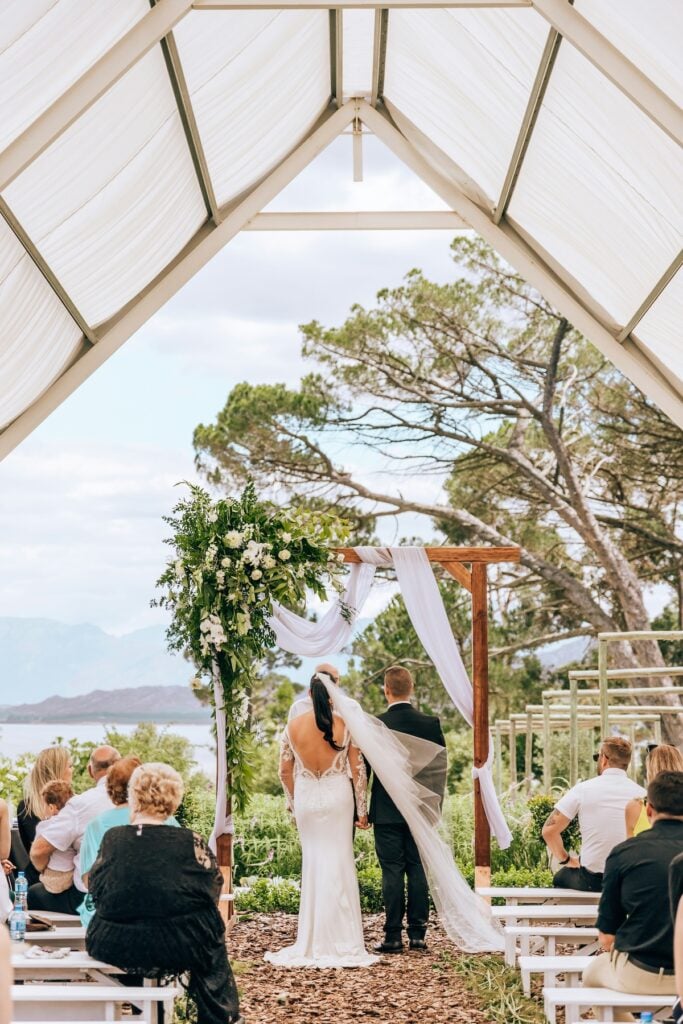
We love an outdoor wedding (we really do!). They look unreal in photos and have a way of going sideways for guests in about 15 specific ways most couples never think to plan around. The first hour usually goes fine. By hour two, people are fanning themselves with the ceremony program, slapping mosquitoes off their ankles, and trying to figure out how long until cocktail hour.
When you shop links on our site, we may earn a small commission at no cost to you. Learn more.
Outdoor weddings take about twice the planning of an indoor one. Climate, bathrooms, bugs, the lighting after dark, the wasps that show up at the bar in September. All of it becomes your problem to solve.
A too-cold ballroom is mildly uncomfortable. A too-cold lawn at 9pm with no shawls in sight and the bar shut down for speeches is a story your guests will tell for years. The couples who pull off the magazine-cover outdoor wedding plan around the 15 below before the wedding day.
1. The Sun Is Directly in Their Eyes During the Ceremony
The most common outdoor ceremony complaint is being unable to see the couple, because the late-afternoon sun is sitting right behind them. A 3 or 4pm summer ceremony with guests facing west means every adult in the audience is squinting through the vows with one hand cupped over their eyes. It also means half your ceremony photos will have rows of guests covering their faces. None of those photos is the one going on the wall.
The fix is two parts. First, talk to your venue or planner about ceremony orientation before they set chair placement. Ideally, the couple should face north or south so the sun is on the side, not behind them or in your guests’ eyes. If your venue layout doesn’t allow that, move the ceremony to 5:30 or 6pm so the sun is lower and softer (which also photographs better). Second, stash a basket of paper fans at the back of the ceremony aisle with a small sign so guests can grab one as they walk in. Bonus: they double as program holders.
Smart move: Have your planner do a sun-direction check at the exact ceremony time on the same calendar date one year prior. Apps like Sun Surveyor and PhotoPills will simulate it on your phone in two minutes.
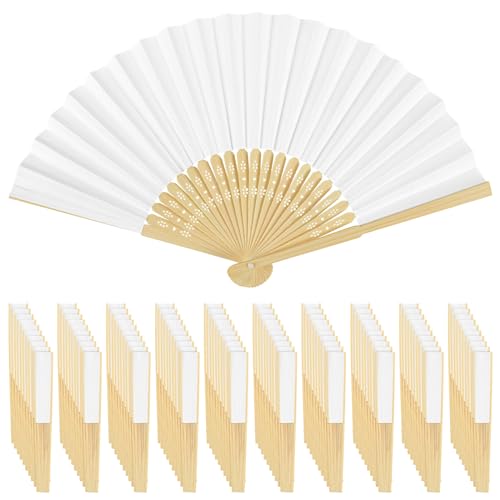
White Folding Paper Hand Fans (100-Pack with Bamboo Handles)
The #1 pick for sun-facing ceremonies. Bulk pack covers most guest counts, folds flat for the basket at the aisle, and the bamboo handles photograph cleaner than the plastic kind. Lay them in a flat basket with a small chalkboard sign at the ceremony entrance.
2. The Wind Picks Up Right When You Say Your Vows
Outdoor weddings get exactly one shot at the unity-candle moment, and a 12-mph gust at the wrong second blows it out, flutters the program in your officiant’s hand, kicks the bride’s veil into her face, and scatters your escort cards across the lawn. Wind also wrecks ceremony audio, especially if the mic doesn’t have a foam windscreen.
The fix is small physical changes ahead of the wedding day. Weight every escort card with a small rock, shell, or branded weight (your stationer often sells matching ones). Use hurricane glass around every candle, including the unity setup. Ask your ceremony musician for a foam windscreen on any handheld or lavalier mic; they cost about $5 and almost no vendor brings one without being asked. If your venue is exposed, check the weather the week of and look at which direction the wind usually comes from at ceremony time, then position your altar perpendicular so wind crosses you, not blowing toward you or the guests.
Heads up: Veils flutter wildly above 8 mph. If wind is in the forecast, a circular weighted hem or a fingertip-length veil sits flatter than a cathedral one. Bring a backup short veil to swap into for portraits if needed.
3. The Folding Chairs Get Brutal After Twenty Minutes
The white plastic folding chair is the wedding rental default, and on grass, in formalwear, in heat, with no back support, for a 30-minute ceremony, most guests over 50 are visibly shifting by the halfway point. The chair becomes the thing they’re thinking about instead of your vows.
The fix is one phone call to your rental company. Padded folding chairs run an extra $1 to $3 per chair vs. the standard white wood or resin. At 100 guests, that’s $100 to $300 added to your rental, which is meaningful but not budget-breaking, and the comfort delta is huge. If you’ve already booked the standard chairs, ask whether they have padded seat cushions to add à la carte. Reserve the most padded options for grandparents, anyone with mobility needs, and anyone pregnant. For ceremonies over 25 minutes, this is the upgrade nobody talks about and everyone notices.
Trust this: A 30-minute ceremony with readings, music, and full vows is what makes the moment land. Upgrade the chairs instead of cutting the program.
4. They Can’t Hear a Word of the Ceremony
Outdoor ceremonies have no walls to bounce sound back to the audience. Without a microphone and a proper speaker, guests past row three are missing 60 to 80% of what’s being said. The vows you wrote, the officiant’s story about how you met, and the reading your sister flew in to give all disappear into the open air. People feel left out, they get distracted, and the energy in the audience drops noticeably about ten minutes in.
The fix is a wired or wireless lavalier mic on the officiant, a clip-on mic on whichever partner speaks first (it can be hidden under a lapel or inside a dress), and at least one freestanding speaker at the ceremony site. Most ceremony musicians will provide the PA setup for an extra $100 to $250, or your DJ can loop it into their package. Confirm this in writing with whichever vendor is handling it, because “we’ll bring a small speaker” usually means a speaker that’s too small.
Pro tip: If you have older guests or anyone hard of hearing, reserve their seats in rows 2 through 4. Acoustically, that’s the sweet spot for outdoor ceremonies. Front row is too close to the music speakers, and beyond row 5 you start losing words.
5. Their Heels Are Sinking Into the Grass
If your ceremony is on a lawn, anyone in heels will spend cocktail hour standing on one foot while they try to pull their other heel out of the ground. By the end of the night, several of them will have given up and gone barefoot or borrowed flats from the bridal suite (assuming there is one, which on a lot of outdoor venues, there isn’t).
The fix is a basket of clear heel protectors at the entrance to the ceremony with a small sign that reads “for our outdoor venue, please help yourself.” The Solemates brand is the only one we’ve seen consistently work; the off-brand versions fall off after a few steps. A bridal pack of 12 clear pairs runs around $40 on Amazon and covers most of your guests in heels. For a lawn ceremony, this is the highest-impact $40 you’ll spend on guest comfort. Add a line to your wedding website ahead of time letting guests know the ceremony is on grass so anyone who’d rather bring block heels or flats can plan ahead.
Trust this: Guests will not bring their own heel protectors even if you tell them on the website. Almost nobody bothers unless the basket is sitting at the venue entrance.
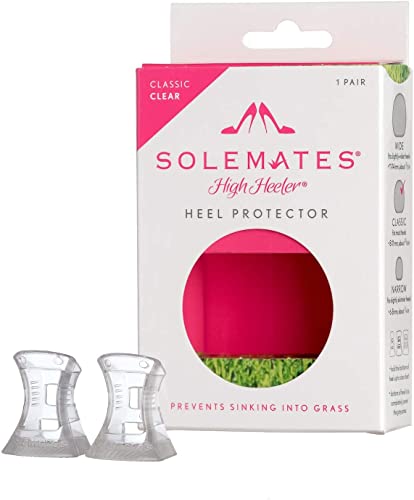
Solemates Heel Protectors Classic Bridal Pack (12 Clear Pairs)
The #1 pick for grass and gravel ceremonies. Founder-made, featured on Shark Tank, and the only heel protector we’ve seen guests not abandon halfway through cocktail hour. Twelve pairs in clear so they work on any shoe color.
6. The Walk from Parking to the Ceremony Is a Quarter Mile
A lot of outdoor venues have parking 200-500 yards from the ceremony site, and that walk is across grass or gravel in formalwear and heels. Your older guests, anyone with mobility needs, and parents managing kids will arrive flushed, sweaty, and stressed before they even sit down. Then they’ll do it again in the dark on the way out.
The fix is signage every 75-100 feet (printed arrow signs on small stakes), shuttle service or a golf cart for anyone who needs it, and a clear map and arrival instructions on your wedding website at least two weeks out. For destination weddings or venues with confusing entrance gates, post a note: “look for the white sign at mile marker 4, turn at the second gate.” Include the parking lot pin as a Google Maps link. Even small upgrades (one shuttle van running for 45 minutes pre-ceremony) eliminate the problem entirely for the people who need it most.
Best for: Farm venues, vineyards, beach venues with long boardwalks, private estates, and any venue where the ceremony site isn’t directly next to the parking area.
7. There’s No Shade During Cocktail Hour
If your ceremony is at 4pm in July and cocktail hour starts at 4:45 on a sun-baked lawn with no canopy, your guests have just sat through a hot ceremony and are now standing in direct sun holding a melting cocktail. By the time they sit down for dinner, half of them are mildly heat-sick and not having fun.
The fix is shade you bring with you. A sailcloth canopy or stretch tent over the cocktail area runs $800-$2,500 for the night and changes the experience completely. If a full tent is out of reach, market umbrellas in stands (the same ones you’d see at outdoor restaurants) rent for $25-$50 each and cluster well over cocktail tables. Position the bar in the shadiest spot available, and place high-tops on the shade side rather than evenly across the lawn. Add a “shade lounge” in the corner (a few sofas, a rug, and one big umbrella), and you’ve also solved seating for the guests who can’t stand for the full hour.
Heads up: A white tent in direct sun is still 5-15 degrees cooler underneath it. Even a basic frame tent rental beats an unshaded lawn for guest comfort.
8. There’s a 90-Minute Gap With Nothing to Drink
Lots of outdoor weddings have a gap between the ceremony ending and cocktail hour starting, because the wedding party is off taking photos and the venue is flipping the ceremony space. Guests are then standing on a lawn in the sun with no water, no shade, and nothing to do for an hour. By the time cocktail hour starts, half of them are dehydrated and over it before the first drink is even in their hand.
The fix is a self-serve water and lemonade station set up where guests exit the ceremony, with stacks of compostable cups, a basket of sunscreen and bug spray nearby, and a small sign letting guests know cocktail hour starts at [time] over at [location]. Two dispensers (one infused water, one lemonade or iced tea) plus the cups and ice cost about $75 to set up and prevent the entire pre-cocktail-hour slump. If your timeline has any gap longer than 20 minutes between ceremony and cocktail hour, this is the easiest fix on the list.
Pro tip: Tray-pass cold water during the ceremony itself if temperatures are above 80°F. According to The Knot’s 2026 Real Weddings Study, 72% of couples said guest comfort was their top planning priority, and small moments like passed water during the vows are the kind of move your guests will mention afterward without prompting.
9. The Wasps Show Up Right When the Drinks Do
Outdoor bars and dessert tables attract yellow jackets and wasps in late summer and early fall, especially anywhere with fruit, sugar, or open drinks. By dessert, guests are picking wasps out of their wine glasses and the kids’ table is a war zone.
The fix is two parts. First, hang a couple of RESCUE disposable yellow jacket traps in trees or on stakes about 20 to 30 feet upwind of the bar and food area, set up at least two hours before the event. They lure wasps away from where guests are, into the trap, and the wasps don’t come back out. Second, ask your bartender to set out covered drink lids or stacks of small cocktail napkins and keep open garnishes (lemon wedges, sugar rims) under a glass cloche on the back bar rather than within reach. Skip fruit-forward decorations on the cake table.
Trust this: RESCUE traps only work if they’re far enough away from where you want to be. Putting them next to the bar is worse than not having them, because you’re pulling wasps into the wrong spot. Twenty feet upwind, in a tree if possible, is the move.
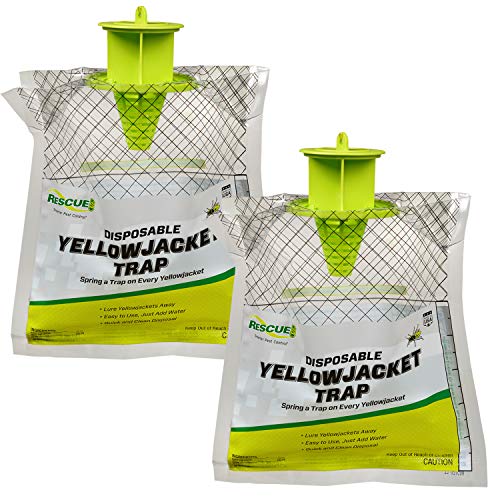
RESCUE Disposable Yellowjacket Trap (2-Pack, Eastern Formula)
The #1 pick for late-summer outdoor receptions. Just add water to activate the lure, hang 20-30 feet upwind of the bar two hours before guests arrive, and they pull wasps away from the food and drinks for the entire night. Disposable, so you toss the whole thing at the end. Pick the Eastern formula east of the Rockies, Mountain & Pacific west of them.
10. The Mosquitoes Show Up Right When Cocktail Hour Starts
Mosquito biting peaks in the 30 minutes before sunset and the two to three hours after, according to the CDC and just about every pest control resource. That is exactly when most outdoor cocktail hours happen. You can have the most beautiful golden-hour setup imaginable, and if your guests are slapping their forearms every 90 seconds, that’s what they’ll remember.
The fix is layered. Set up two or three Thermacell repellers around the perimeter of the cocktail-hour area at least 30 minutes before guests arrive. Each one creates a roughly 20-foot mosquito-free zone and reaches full strength in about 15 minutes. Add a small basket of EPA-approved repellent (we love the Repel Lemon Eucalyptus formula because it doesn’t smell like a hardware store) at the entrance, with a sign so guests can spray ankles and wrists. If your venue is near standing water, ask whether they spray the property in the days leading up to the event. Many venues do as part of the rental fee, but only if you ask. For destination weddings in Florida, Texas, or any beach venue, this is non-negotiable.
Heads up: Citronella candles look pretty but barely work. They reduce bites by less than 50% within a few feet of the flame, per multiple peer-reviewed studies. They’re decor, not protection. The Thermacells are the actual protection.
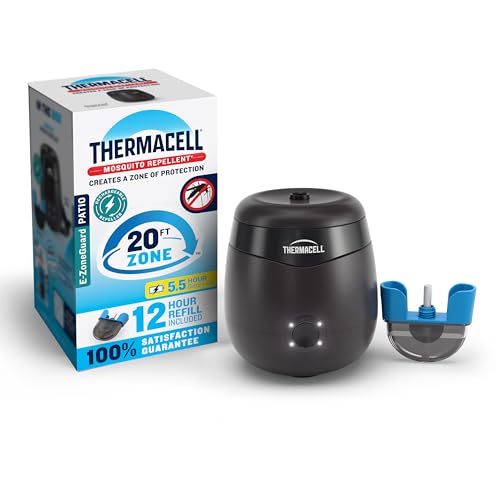
Thermacell E55 Rechargeable Mosquito Repeller
The #1 pick for outdoor cocktail hours. Scent-free, flame-free, 20-foot mosquito-free zone per unit, and full protection in 15 minutes. Set two or three around the perimeter of cocktail hour and your guests will stop noticing the bug situation entirely. EPA-reviewed.
11. Their Hair and Makeup Are Melting by Hour Three
In humidity above 60%, even the best wedding hair and makeup starts to slip by the third hour. Mascara migrates, foundation oxidizes, curls drop, and bridesmaids’ hairspray gives up entirely. By dinner, half the bridal party is touching up in a porta-potty using a phone flashlight, and your guests are wiping mascara off their cheeks at the table.
The fix is a small powder room basket and one air-conditioned space within walking distance. The basket lives at the bathroom or at the back of the venue: blotting papers, a bottle of setting spray, two small mirrors, mini deodorant wipes, a few bobby pins, mints, and a small battery-operated fan. If your venue has any indoor space at all (clubhouse, prep kitchen, dressing room), keep it open and air-conditioned for the night and tell guests they can use it for touch-ups. Tip your hair and makeup artist to come back for an hour-five touch-up if the budget allows; most will for $75-$150.
Pro tip: A travel-size dry shampoo in the bathroom basket saves the bridesmaids whose updos have flattened by the first dance. Olaplex or Living Proof are both good fits; even drugstore Batiste works in a pinch.
12. It Drops 20 Degrees After Sunset and They’re in a Slip Dress
Most outdoor weddings underestimate the temperature swing between cocktail hour and the end of the reception. A 78°F early evening can drop to 58°F by 10pm, and many of your guests are in summer dresses with bare arms. By the second course, half the table is borrowing jackets and the other half is asking when the heaters are coming on.
The fix is a basket of inexpensive pashmina shawls at the reception entrance. Stick to neutral colors (cream, blush, sage) so they work for any wedding palette. A 12-pack runs about $40 to $60. Pair that with two or three patio heaters along the perimeter of the dance floor (most rental companies carry them for around $75 to $100 each for the night), and your guests will stay through the last song instead of leaving early. Coordinate with your caterer to keep coffee, tea, and a cocoa or hot toddy option on offer from 9pm onward.
Smart move: Ask your venue or planner what time temperatures have dropped historically for outdoor events at that location. They’ll usually know within a few degrees, and that one data point tells you whether you need one shawl basket or three.
13. The Bathroom Is a Plastic Box in a Field
A standard construction porta-potty is the fastest way to break the spell of a beautifully designed outdoor wedding. Guests in formalwear do not want to step over plywood ramps into a 90°F plastic box with hand sanitizer and nowhere to set down a clutch. They’ll hold it as long as they can, leave earlier than they planned, or get unhappy enough that traffic to the dance floor drops noticeably.
The fix is a portable restroom trailer, not a standard porta-potty. Trailer units have actual flush toilets, climate control, running water at sinks, full-length mirrors, and lighting that works for touch-ups. Rentals start at around $1,500 and run up to about $3,500 depending on size, season, and region. For a wedding above 75 guests, this is the upgrade that lands hardest with guests and almost nobody regrets. If a trailer is fully outside your budget, you can dramatically improve a standard porta-potty by spending $50 on a small basket of essentials inside (bobby pins, hairspray, blotting papers, tampons, deodorant wipes, mints) and a battery-operated string light strung along the ceiling.
Best for: Backyard weddings, farm venues, vineyard venues, and any private-property outdoor wedding without a permanent bathroom building.
14. There’s No Path Lighting Once the Sun Goes Down
Outdoor venues that look magical in daylight get pitch dark fast after sunset, and guests in heels walking across grass and uneven ground in formalwear is a sprained-ankle scenario waiting to happen. The walk to the bathroom, the path back to parking, the route from cocktail hour to reception. All three go dark within 30 minutes of sunset, and your guests are using phone flashlights to get around.
The fix is path lighting installed before sunset along every walking route guests will use after dark. Solar stakes work for low-traffic paths (driveway edges, bathroom walks) and need 6-8 hours of charging during the day to run all night. For higher-traffic walks (ceremony to reception, dance floor to bar), rent or buy bistro string lights overhead at 8-10 feet, which are the single most photographed lighting element in outdoor wedding portfolios and double as decor. If your venue is large or remote, ask your planner about hiring a lighting designer; they’re more affordable than couples think (often $800-$1,800 for a backyard or farm wedding).
Pro tip: Test your lighting setup the night before at exact dusk time. Things that look fine at sunset are pitch black 30 minutes later, and that’s when most of your guests are walking to their cars.
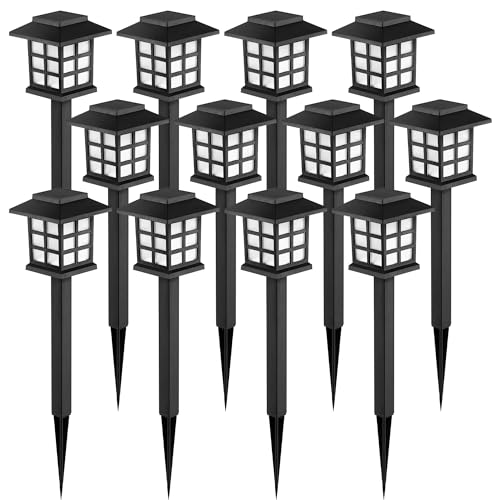
GIGALUMI Solar Pathway Lights (12-Pack, 10-Hour Runtime)
The #1 pick for after-dark walking paths. Stake them in along walkways, bathroom routes, and parking returns the morning before the wedding so they’ve got a full day of charging. Auto on at dusk, 10 hours of light, IP65 waterproof. The 12-pack covers most backyard or farm-venue layouts.
15. The Kids Are Bored With Nothing to Do
Outdoor weddings have no walls, so kids who are bored at a long reception don’t just fidget at the table; they run laps around the dance floor, knock over candles, get into the gift table, and generally make every parent in the room tense. The parents don’t enjoy themselves, the kids don’t enjoy themselves, and a meaningful chunk of the photos are of toddlers being wrangled.
The fix is a small activity bag at each kid’s seat and a designated kid zone outside the main reception area. The activity bag costs $5-$8 per kid to assemble: a small notepad and crayons, stickers, a mini puzzle, a wedding-themed coloring page (free printables online), a sealed snack, and maybe a glow stick for after dark. The kid zone is a corner with a blanket, lawn games (giant Jenga, ring toss, sidewalk chalk), and ideally a sitter on the clock for the dinner-and-dancing window ($150-$300 for the night through a local babysitting service or your planner’s contacts). Both fixes together cost less than $500 for a wedding with 8-12 kids, and the parents will tell you it’s the best gift you gave them all year.
Heads up: A kid-friendly catering option (chicken tenders, pasta, a fruit cup) keeps younger kids in their seats during dinner instead of grazing at the bar. Most caterers will quote this as an under-12 menu for $25-$45 a head.
So, What Actually Matters?
Nothing on this list breaks a wedding. Plenty of beautiful outdoor weddings happen every year with porta-potties, no heel protectors, no kid zones, and a 90-minute gap nobody pre-empted with lemonade. Your guests will love being there either way because they love you.
What this list does is shift the experience from “really pretty, but…” to “the best wedding I’ve been to all year.” The whole roster of 15 fixes runs anywhere from $500 (if you stick to the small basket-and-station items) up to about $10,000 (if you add the shade tent, the restroom trailer, and a full lighting design). Most couples land in the $1,500-$3,000 zone after picking the 6-8 fixes that match their venue. Our Smart Wedding Planner Guide has the full venue-tour question checklist for outdoor weddings if you want to walk in knowing exactly what to ask. You can also use our budget tool below to see where these guest-comfort line items fit in your overall plan.
Plan the second hour as carefully as the first. That’s the difference between guests who close down the dance floor and guests who slip out after the cake.
Are you overspending on your wedding? This 60-second quiz will tell you.
Most brides go into planning with a number in their head and no idea where it's actually going. Enter your budget and guest count, and get a clear picture of exactly where your money is at risk, what you're most likely to overspend on, and where you can cut without anyone noticing.
What matters most to you?
Every vendor will tell you: unless you have an unlimited budget, you HAVE to prioritize. Tell us what matters most to you so your results are specific to YOUR wedding — not some generic checklist.
Your budget has a blind spot.
What’s inside your results
📊Your budget score & #1 blind spot
⚠️Your biggest pressure point
💡Where you’re most likely to overspend & save
💰Your recommended budget breakdown
No spam. Unsubscribe any time.
FAQ
How early should we start planning outdoor wedding guest comfort?
At the venue tour. Ask the venue what they provide (heaters, fans, water service, restroom options, lighting after dark) and what you’ll need to rent or bring yourself. This one conversation tells you whether your venue is set up for outdoor comfort or whether you’ll be sourcing every fix on this list independently.
Do we really need a portable bathroom trailer if our venue has one indoor bathroom?
If your venue has one accessible indoor bathroom for 100+ guests, you’ll have a 10 to 15 person line for most of the reception. Either rent a trailer, or ask the venue if guests can use a secondary indoor space (a clubhouse, lobby, prep kitchen) so traffic doesn’t all funnel to one bathroom.
What’s the absolute minimum to do for an outdoor summer wedding?
Water service at the ceremony, heel protectors at the entrance, one Thermacell where guests will be congregating during cocktail hour, and path lighting before dark. Under $200 total. Huge impact.
Which fixes matter most for a fall or winter outdoor wedding?
Heaters, pashminas, hot drinks after 9pm, and path lighting. The bug section matters less in cooler months; the cold and lighting sections matter more. Don’t skip the wasp traps if your reception runs into October in a warm region; yellow jackets are most aggressive in late summer through first frost.


For Catholics, unless there is a special dispensation, an outdoor wedding invalidates the marriage. It has to be in the church sanctuary or a chapel. There would have to be a second ceremony to validate the wedding and if it happens after the wedding night, they would have to go to confession first, and they probably are not sorry if they choose to go that route, so that becomes an insincere confession.
Wow, a post where the bloggers isn’t dissing professional florists all while using uncredited floral photos.