
If you couldn’t tell already, we have a serious soft spot for a vintage wedding dress over here. And the 1970s had a LOOK. You can flip through an old JCPenney catalog or a $1 copy of Bride’s magazine and place a gown within a year or two, just from the sleeves and the veil.
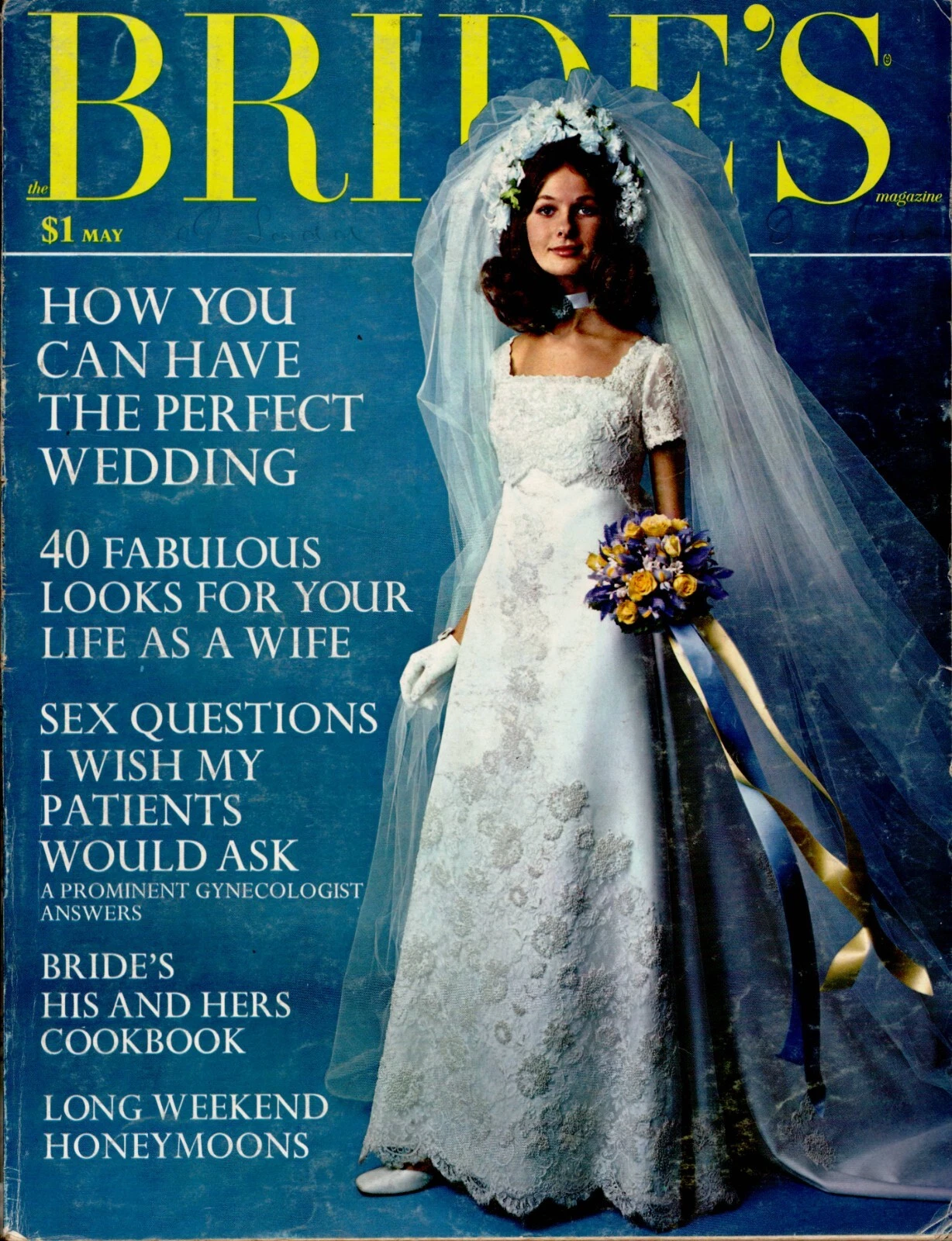
The short-sleeve wedding dress might be the best trend to come from the 1970s! Case in point, this Bride’s cover from a May issue early in the decade. A dollar on the newsstand, a short-sleeve empire gown on the model, and cover lines that could only have run back then: “How You Can Have the Perfect Wedding.” “40 Fabulous Looks for Your Life as a Wife.” “Sex Questions I Wish My Patients Would Ask.” We could not make this up if we tried.
So we pulled a stack of real seventies bridal ads and catalog pages, the kind your mom probably circled in pen, and went looking for the tells. Some of these you’ll recognize from her wedding album. A few you’ll want to copy, because half of this look is creeping back onto Pinterest as we speak.
Vintage bridal is having a moment again (Who What Wear named it one of 2026’s big wedding trends), and a true sixties or seventies gown with the lace and beading still intact can run a bride $300 to $800. Consider this your field guide to the vintage wedding dress look. If your dress checked these boxes, you were a seventies bride, and you had taste.
The Sleeves Were Doing the Most
Start at the arms, because the seventies certainly did. The big three were the bishop sleeve (full and gathered into a cuff at the wrist), the juliet (puffed at the shoulder and fitted below), and the bell, which flared out and kept going.
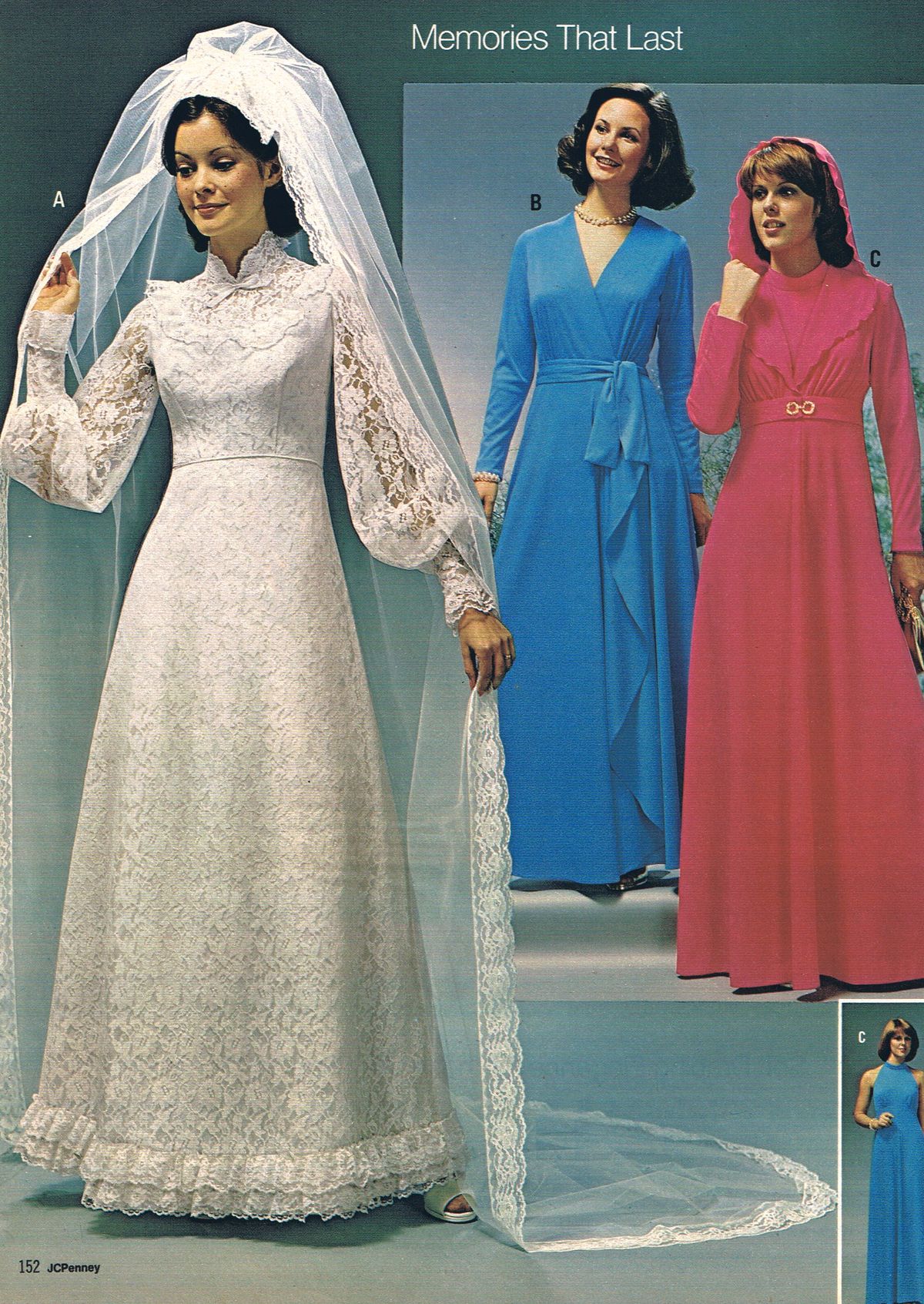
This ad for JCPenney “Memories That Last” included a lace gown and blue and pink jersey dresses, which I’m assuming were wedding guest dresses. Those actually would be pretty stylish by today’s standards! The lace gown on the left has the sheer bishop sleeves and a cathedral veil to match. The product copy is half the fun too. One Penney’s gown promised “bishop-style lace sleeves,” a “stand-up collar,” and a “scalloped hemline,” all in “acetate-and-nylon lace over acetate taffeta lining.”
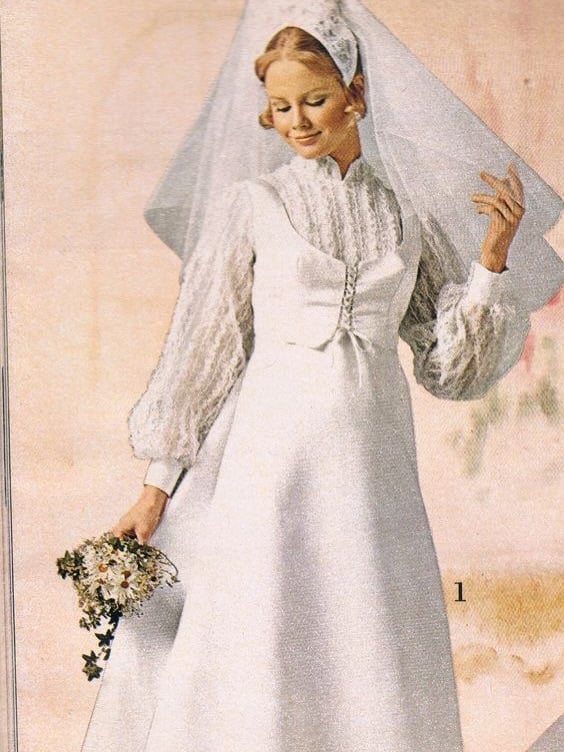
This satin A-line wedding dress had a very interesting and slightly weird lace-up corset front with big bishop sleeves. The arms tell you the decade before you even get to the bodice.
Spot it by: the cuff. A seventies sleeve almost always ends in a tight band at the wrist, so all that volume has somewhere to gather.
The Neckline Climbed All the Way Up
They really, really wanted to cover up your neck in the 1970s! Brides loved a high Victorian collar, the kind that stands up under the chin and closes with a row of tiny covered buttons. It read romantic and a little old-fashioned even then, which was the point.
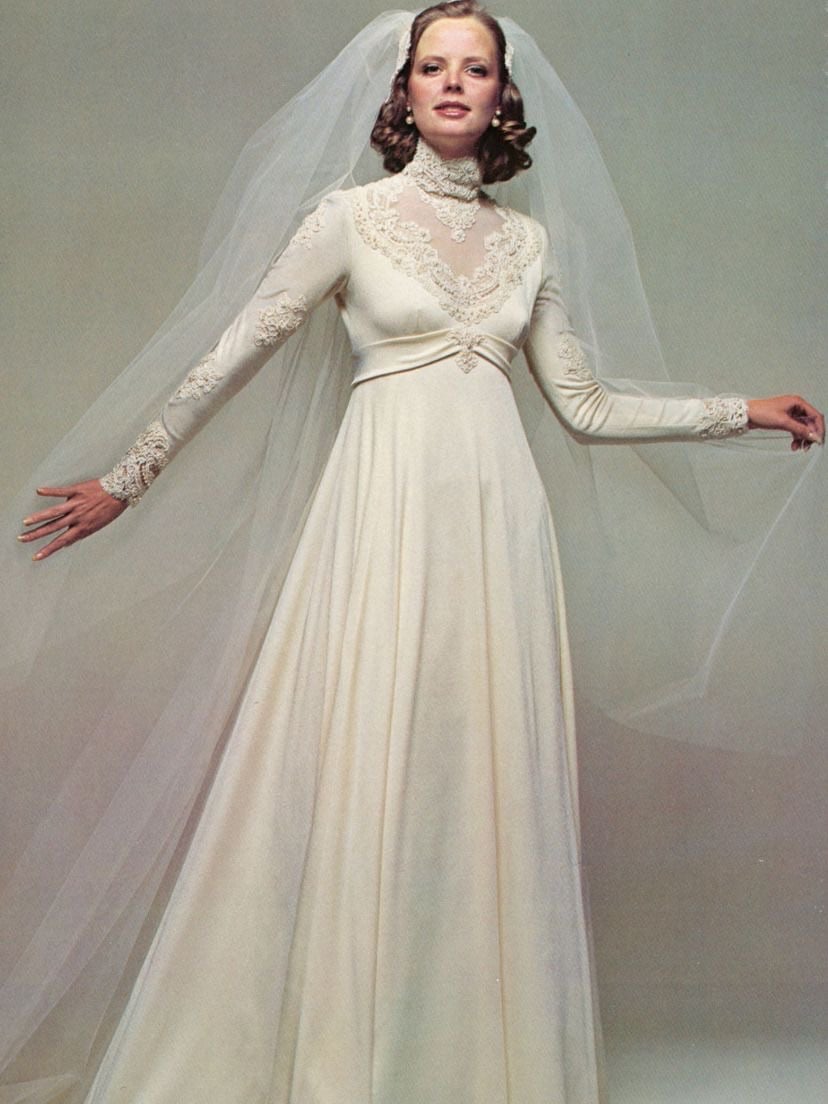
Behold this ivory jersey wedding gown with a high lace collar and an empire waist. A stand collar, a lace yoke you can see right through, an empire seam under the bust, and that soft matte jersey everybody used. Qiana, if you want the fabric name your mom would recognize.
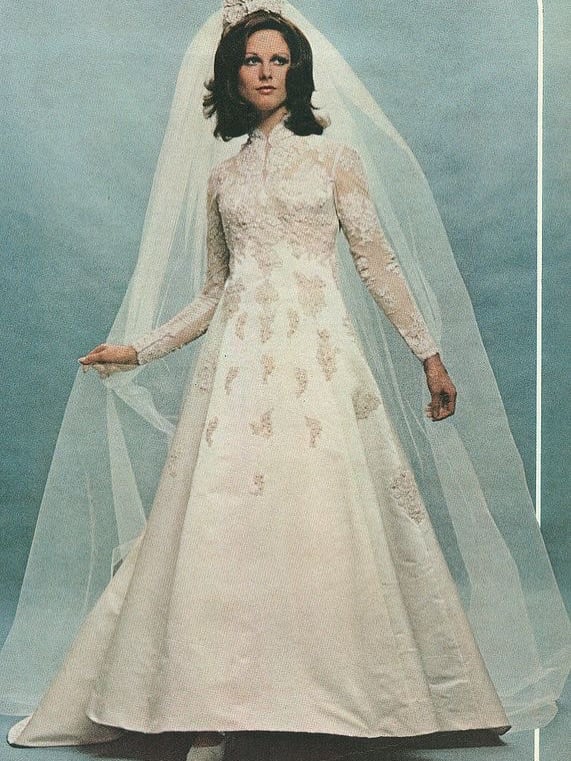
Of all the high-neck wedding dresses, this looks the most stylish, IMHO. It is the same idea in a heavier lace, with appliqués scattered down an A-line skirt and a short pouf veil clipped at the crown.
The tell: a collar that goes all the way up, usually cut in sheer lace or net so it stays soft instead of stiff.
There Was a Cap, a Camelot, and a Whole Cloud of Veil
The veil situation in the seventies deserves its own paragraph. Brides skipped the simple comb-and-tulle and went for a headpiece with a name. The camelot cap sat flat on the crown like a little halo. The juliet cap hugged the back of the head.
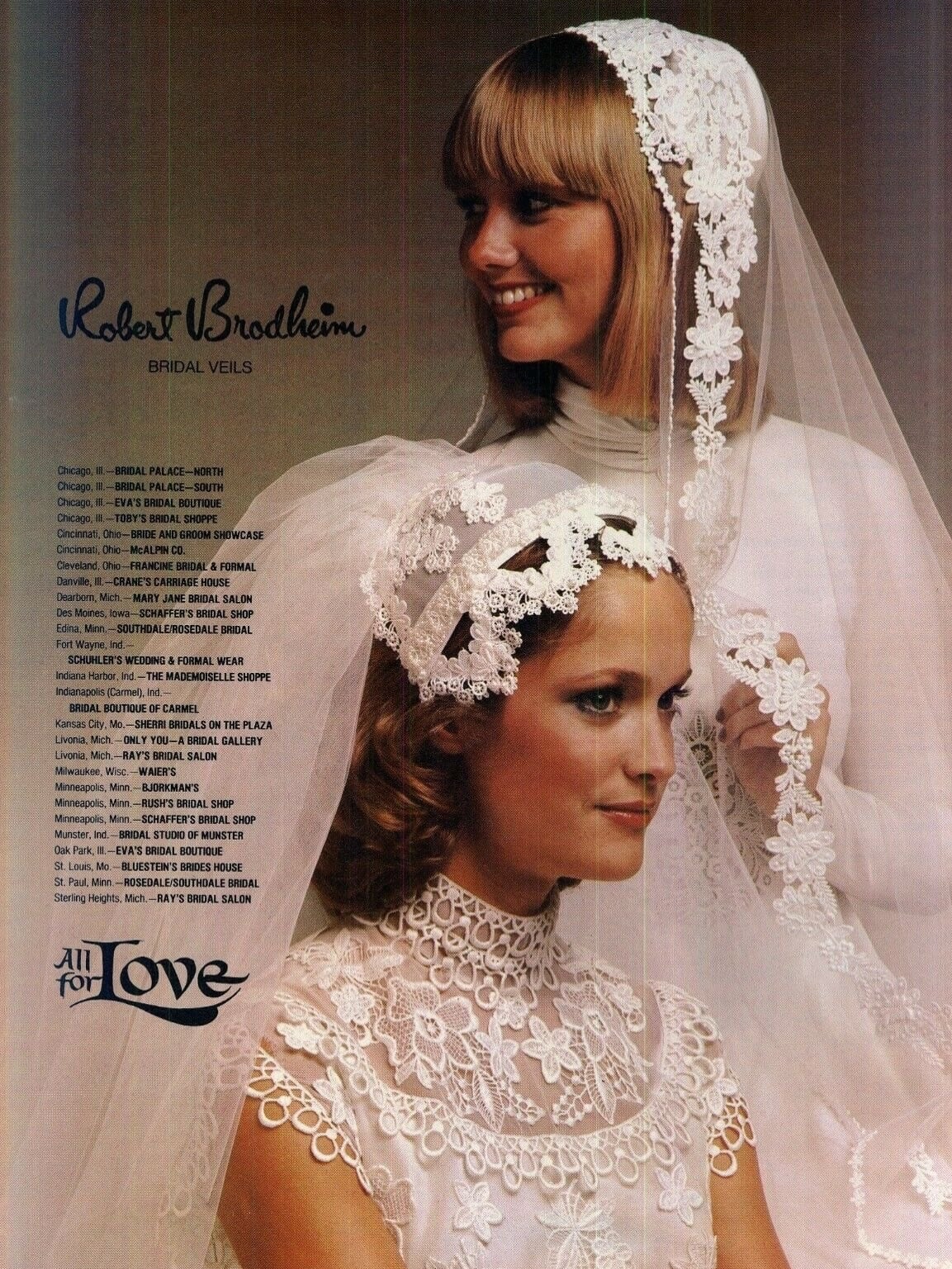
Robert Brodheim’s “All for Love” ad featured two lace camelot-cap veils that were, err, very lacy. The lace runs around the cap and then keeps going straight down the veil, so it frames the whole face. If you copy ONE thing from this entire post, make it the veil!
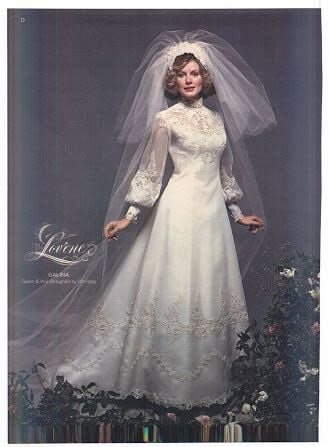
The Galina gown featured a beaded scalloped hem and a little bubble veil. You can still track down caps like these on Etsy, which we get into in our favorite shops for bridal headpieces.
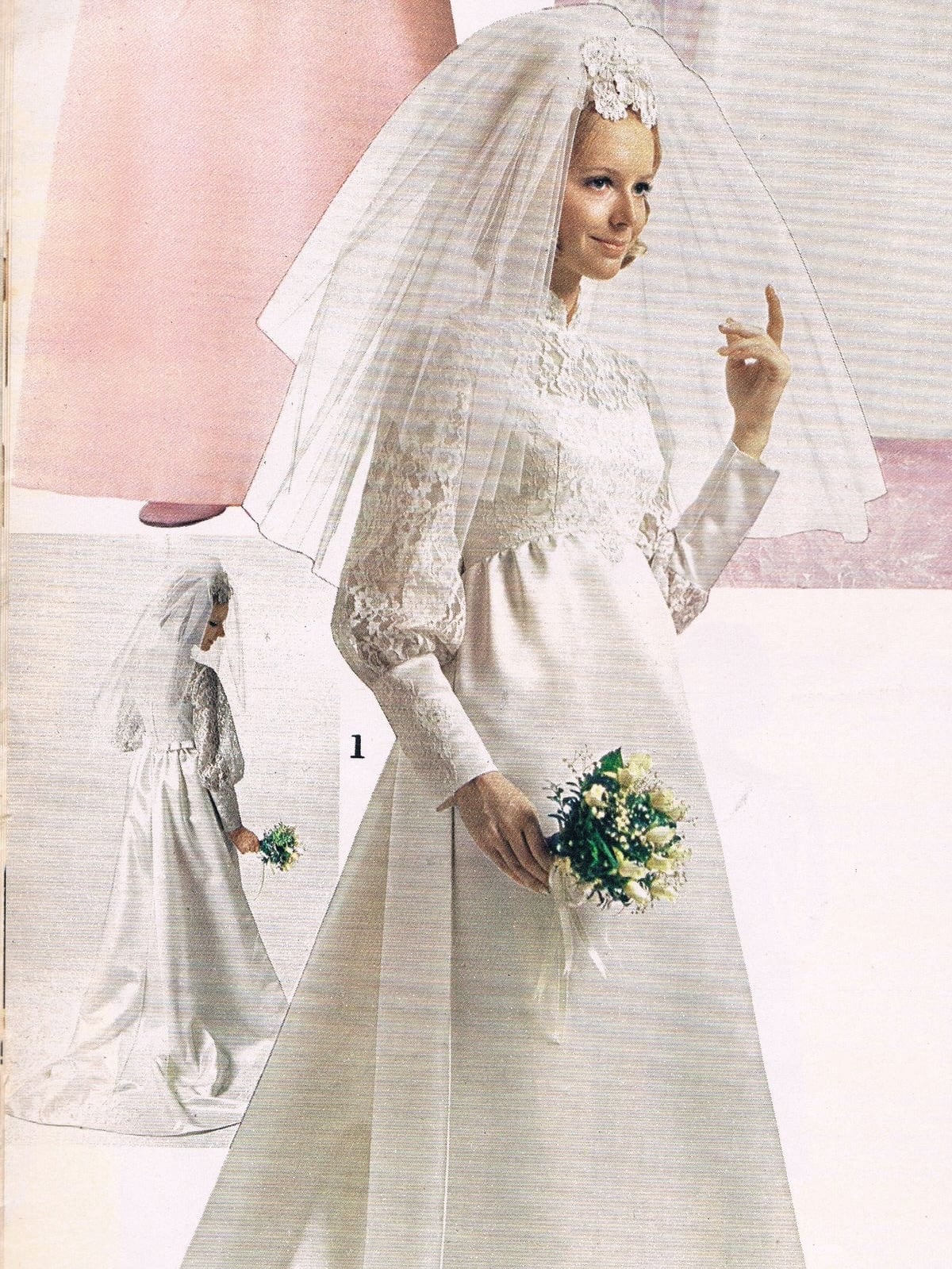
When a bride wanted the full cathedral situation, the veil spilled out past the train. The two-tier veil at least provided a little contrast with high-neck gowns.
Steal it: the lace-edged mantilla is the easiest seventies detail to bring back, and it photographs beautifully from behind.
We’ve seen brides pair a lace-edged mantilla with an otherwise simple gown and walk away with the best of both decades.
Lace. So Much Lace.
Lace did a LOT of heavy lifting in this decade. Not a little trim here and there, but whole bodices, full sleeves, bib fronts, and hems edged three rows deep. There was Venise lace, Chantilly, and crochet that was meant to look handmade. If a gown could hold more lace, trust me, it did.
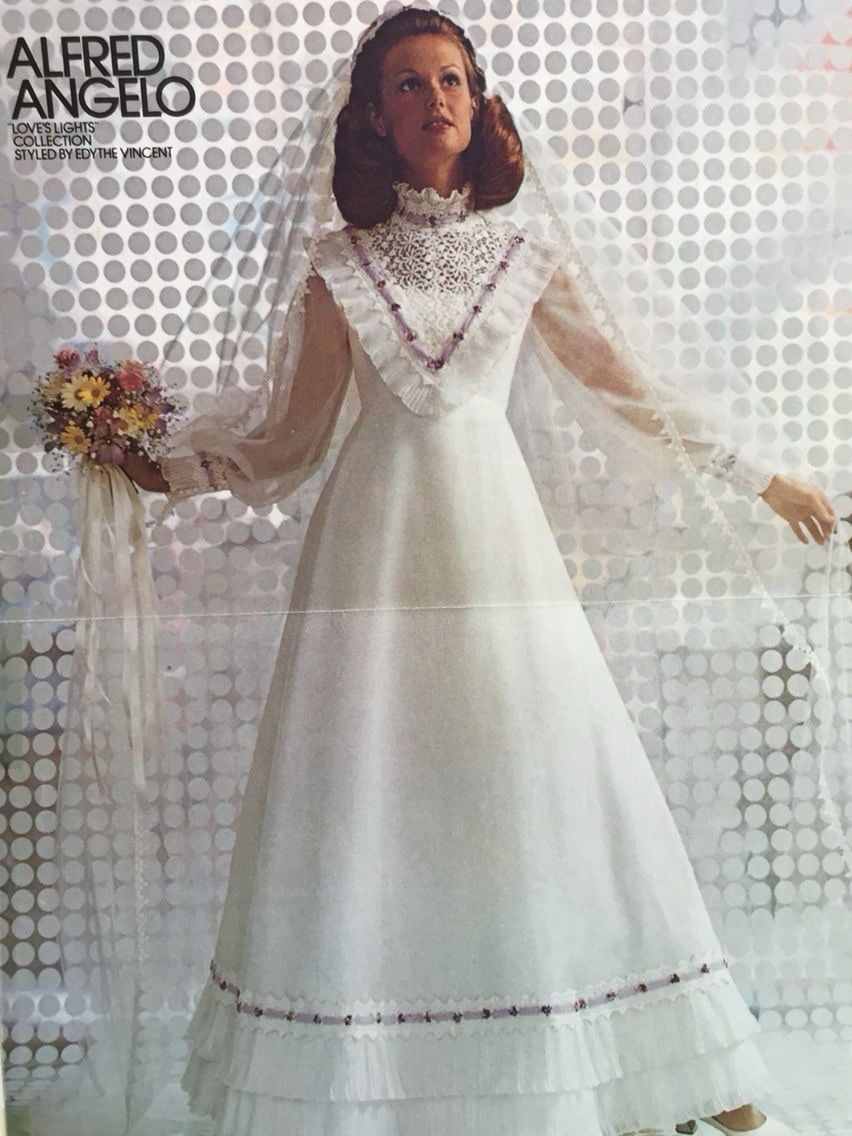
Alfred Angelo’s “Love’s Lights” wedding dress had a crochet lace bib. Perhaps the words “bib” and “wedding dress” should never go together again! Above it sat a high lace collar, with little flowers tracing the empire seam and the hem.
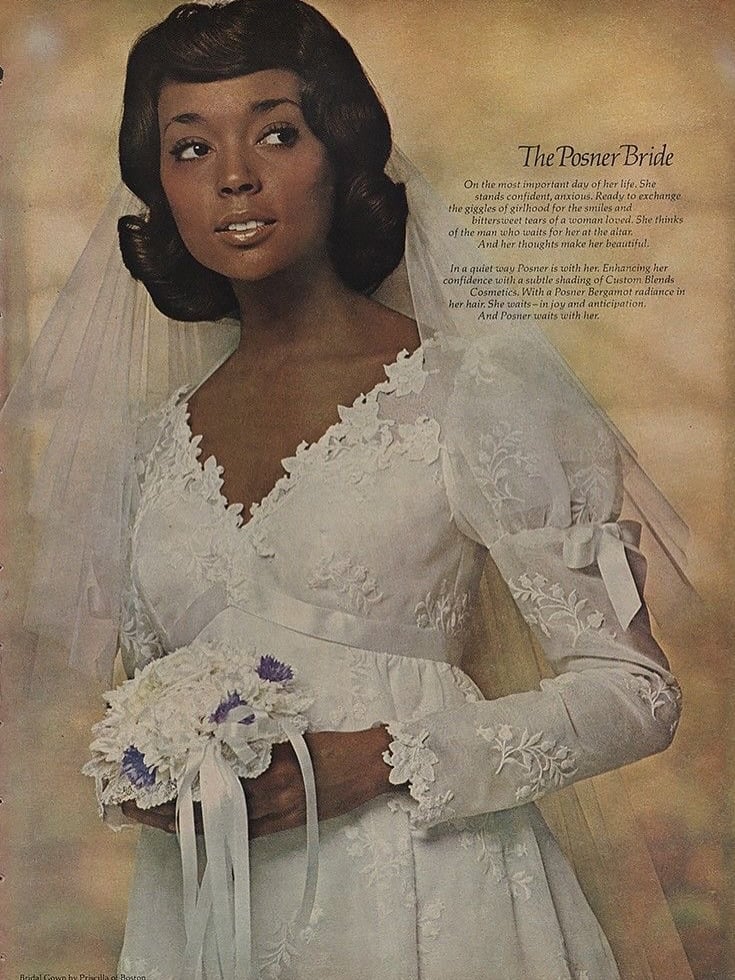
Finally, a neck! The Posner Bride featured a V-neck of scalloped lace and cut-out sleeves with bow ties. The ad copy is pure 1972: “On the most important day of her life. She stands confident, anxious. Ready to exchange the giggles of girlhood for the smiles and bittersweet tears of a woman loved. She thinks of the man who waits for her at the altar. And her thoughts make her beautiful.” Whew. They really do not write them like that anymore!
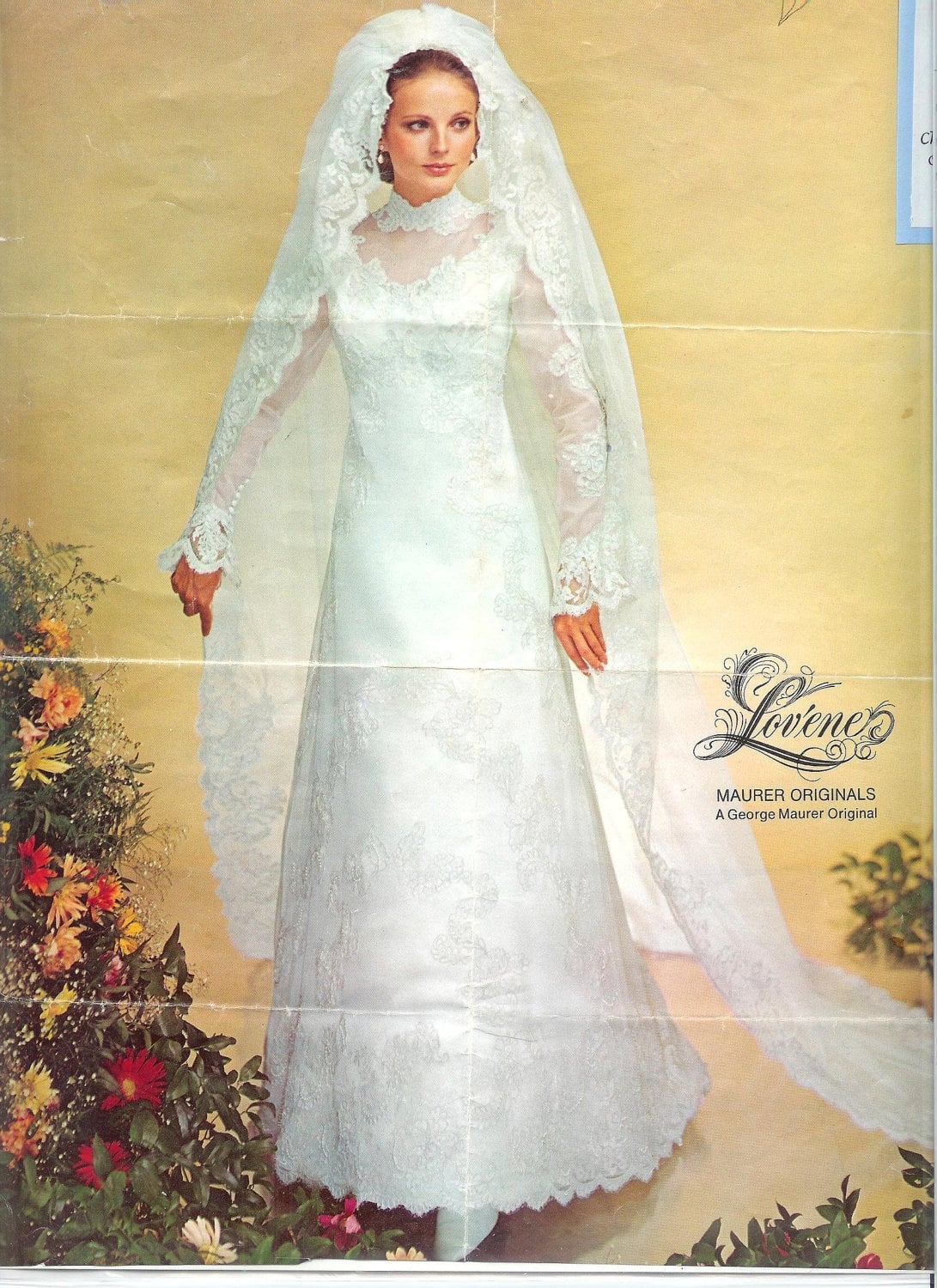
George Maurer’s “Lovène” lace gown was at least simple and elegant, even if it took the lace all the way to the floor and then kept it going up the mantilla. Lace collar, lace cuffs, and a lace border on a veil that reaches the hem.
Fun fact: a lot of these gowns were sewn at home from Vogue and Butterick patterns, which is why you’ll spot the same lace bib on dresses from completely different labels.
Empire Waists and Easy A-Lines
The shape underneath all that lace was usually easy to wear, and that was on purpose. The empire waist (seamed right under the bust, with the skirt falling loose from there) was everywhere, and the A-line was right behind it. Their mothers got married in corseted gowns. Seventies brides were over it. They wanted to breathe and actually SIT DOWN at the reception, and we don’t blame them one bit. Remember the “40 Fabulous Looks for Your Life as a Wife” on that Bride’s cover up top? This is the shape hiding under most of them.
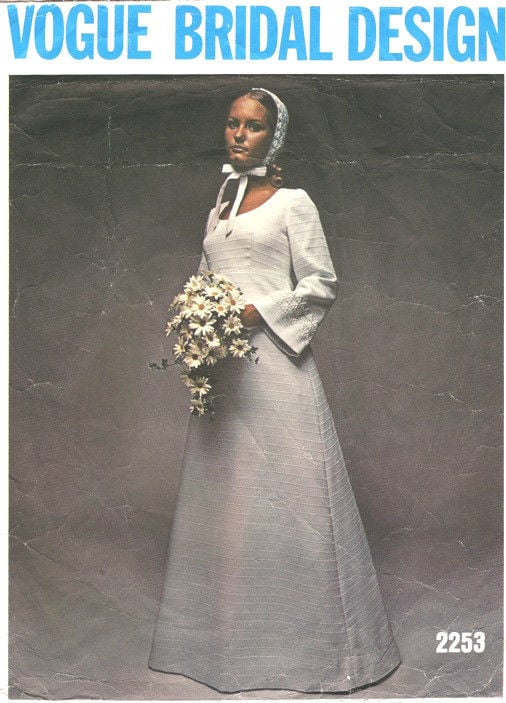
This 1970 Vogue wedding dress pattern featured an A-line gown worn with a headscarf and daisies. We can’t tell if it’s more Twiggy or Amish. Either way, it’s the relaxed end of the look. You could picture it at a backyard wedding or down at the courthouse, which was sort of the whole point by 1975.
Catalog speak: the listings called it a “high-waisted effect.” Your mom called it the dress she could eat cake in.
The Skirt Came in Tiers (and Sometimes Went Full Prairie)
When seventies brides did want drama, they got it from ruffles, not from a corset. Tiered skirts stacked layer on layer of chiffon or lace, and the prairie gown (think Gunne Sax, the label that turned calico-meets-Victorian into a seventies obsession) brought romance to the boho bride before we called it boho.
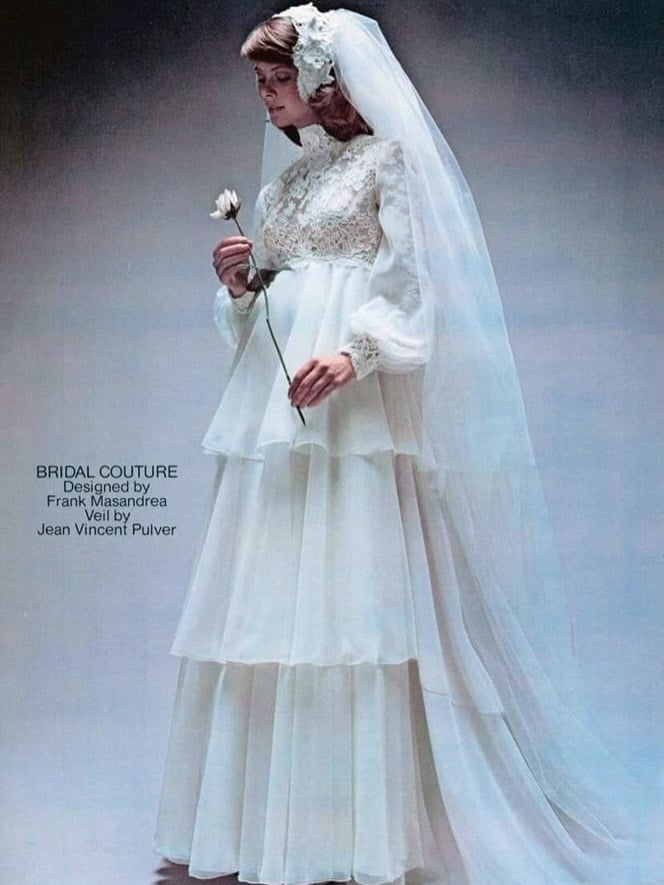
Frank Masandrea’s wedding dress had a lace bib and three tiers of chiffon, falling to the floor like a wedding cake you’d want to wear.
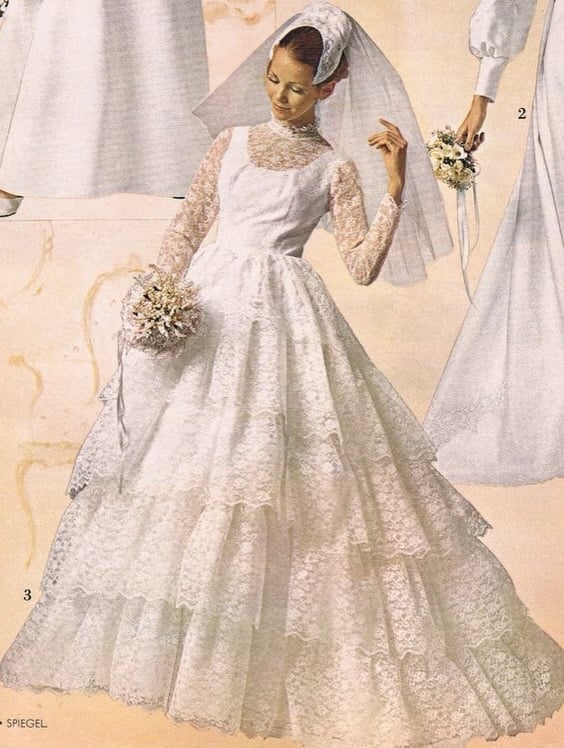
This Spiegel lace ballgown had tier after tier of ruffles, the kind of dress that takes up its own pew.
Back in style: the prairie gown is having a full revival right now, so if your mom kept hers, go look in the attic.
The Bouquet Was Daisies (or a Waterfall of Them)
Even the flowers had a decade-specific look. The seventies bride carried daisies, baby’s breath, and loose wildflowers tied with ribbon, a soft natural bunch instead of a tight formal nosegay. And when she wanted something different, she went all in.
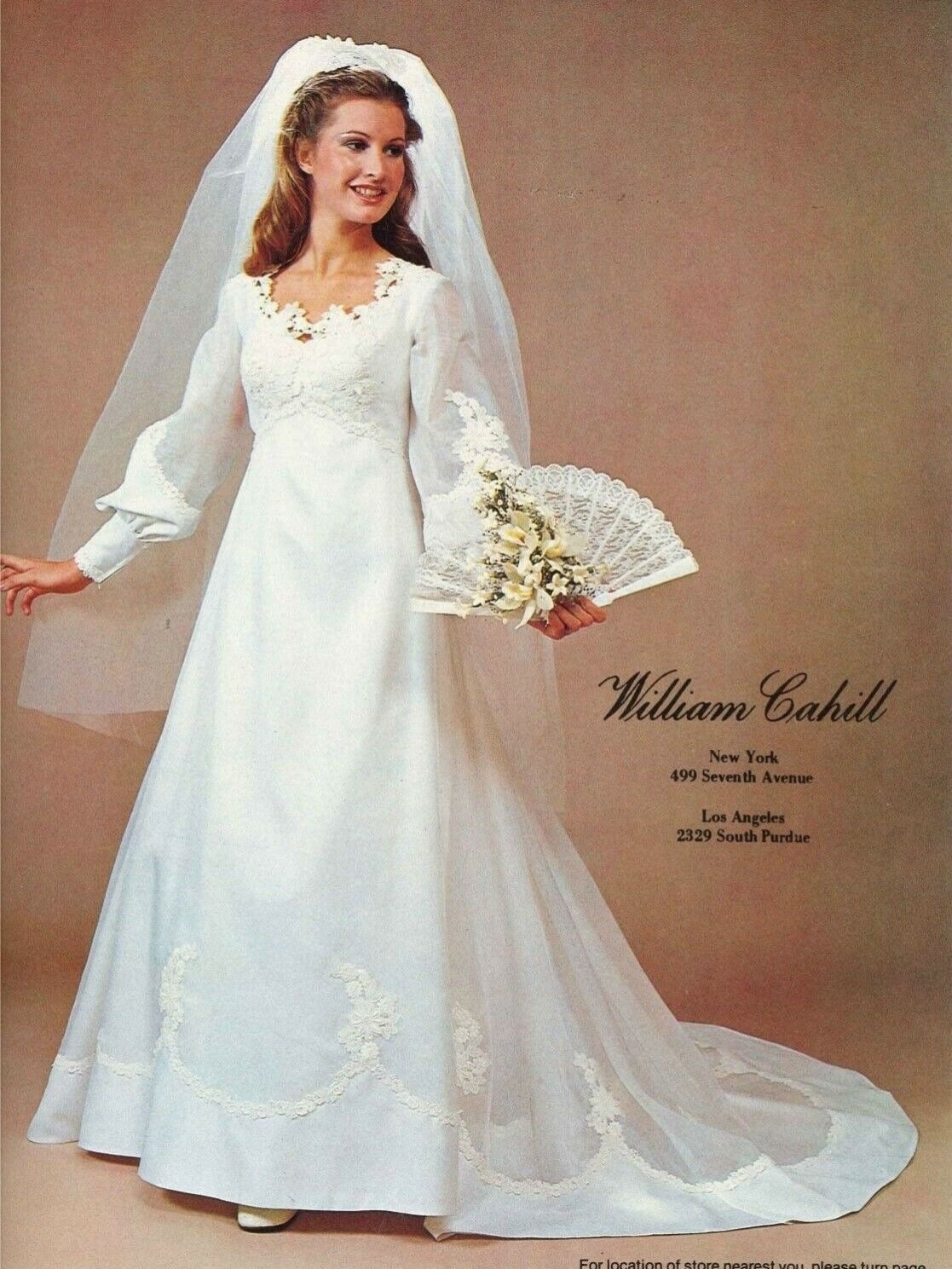
This William Cahill bride was holding a lace fan dressed with flowers instead of a bouquet, which is the kind of detail that makes you stop on a catalog page fifty years later. William Cahill was also okay with a little neck showing (thankfully). If you love a bouquet that breaks the rules, we rounded up more of them here.
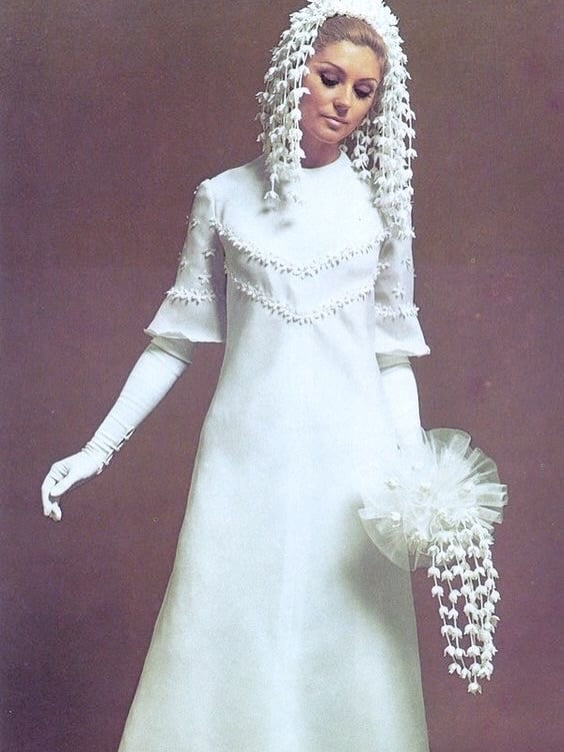
Actually, this one was pretty cool: a Juliet cap cascading into a waterfall of tiny flowers, matched to a trailing “bouquet” that is closer to a waterfall too. Subtlety was not always the goal, and we respect it.
Try it yourself: a loose daisy bunch is the cheapest way to get the seventies feeling, and it reads modern again too.
The Bridesmaids Wore Hot Pink, Sky Blue, or Sunshine Yellow
While the bride stayed in white, everyone around her got the color. Seventies attendants and mothers wore full-length jersey gowns in shades that did not whisper. Hot pink, sky blue, marigold, olive green.
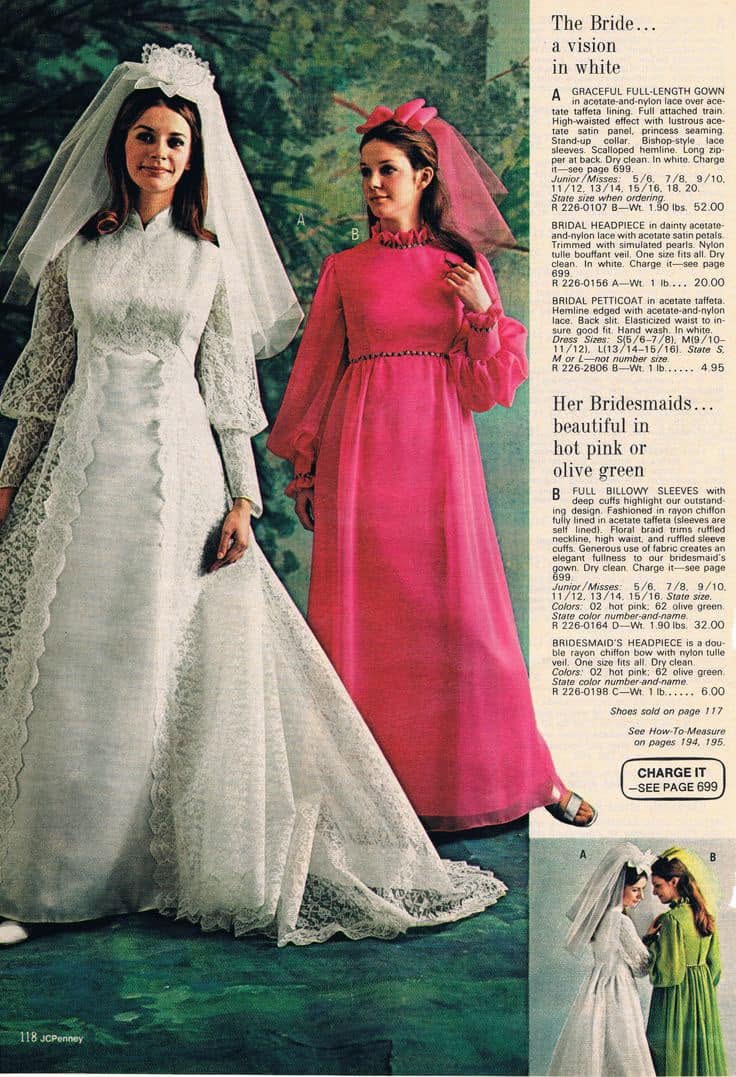
A hot-pink bridesmaid dress? Kind of funky! This JCPenney page lays it out plain as day, with “The Bride… a vision in white” sitting right next to “Her Bridesmaids… beautiful in hot pink or olive green.” The gown ran $52, the headpiece $20, and the petticoat a whole $4.95. A bridesmaid dress was $32. Charge it, see page 699.
The copy for the bridesmaid gown is even better. JCPenney sold “full billowy sleeves with deep cuffs,” “fashioned in rayon chiffon,” with “floral braid” trimming a “ruffled neckline, high waist, and ruffled sleeve cuffs.” Nobody was underselling anything in 1973.
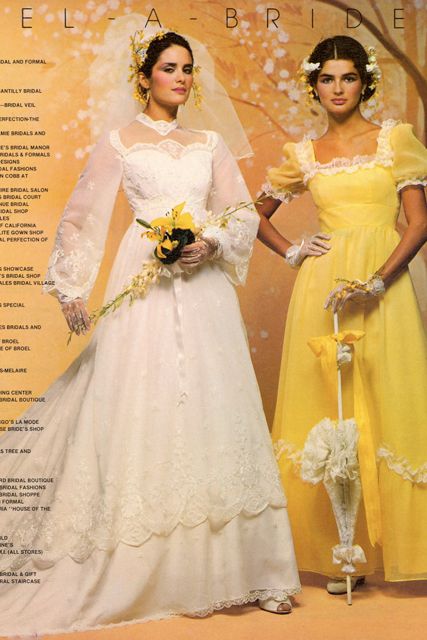
If you had to wear this marigold-yellow bridesmaid dress with a matching parasol, we apologize on behalf of the bride. It came complete with lace gloves, too. Those blue and pink wrap dresses near the top of this post? Same idea. One white bride, a rainbow of everyone else.
Did you know: the all-one-bold-color bridesmaid look is back, now swapped for sage, terracotta, and dusty blue. The seventies got there first. (Here are fun wedding dress colors if you want to run with it.)
Then Came the Showpieces: Hoods, Capes, and Picture Hats
Some seventies brides looked at the high collar and the camelot cap and thought, why stop there? These are the gowns that make a vintage seller gasp, and we are here for every one of them.
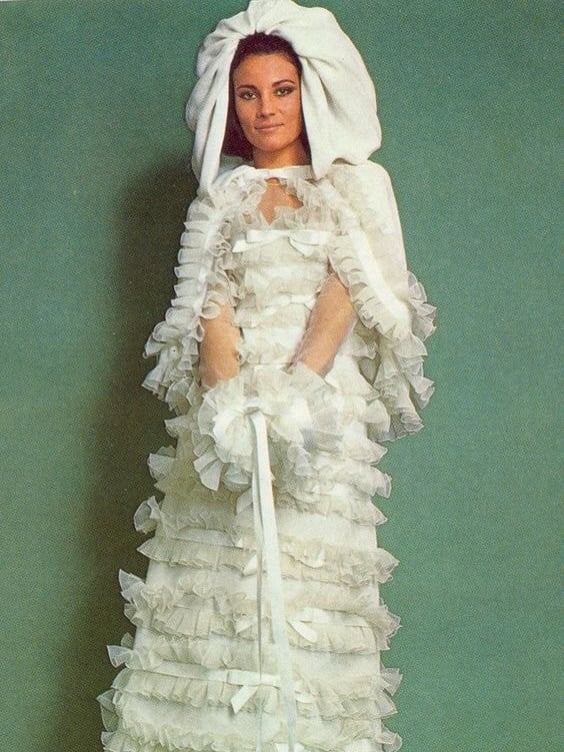
Little Bo Peep called. She finally decided on a wedding dress! This one is hooded and ruffled from the hood all the way to the hem, every tier edged in organza. It is part bride, part medieval, and very much of its decade.
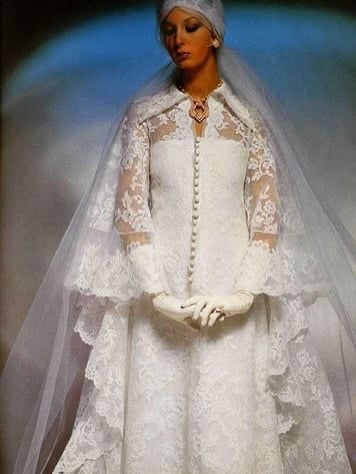
This full lace cape over a lace gown definitely turned heads. There’s a brooch at the throat and long gloves underneath, too.
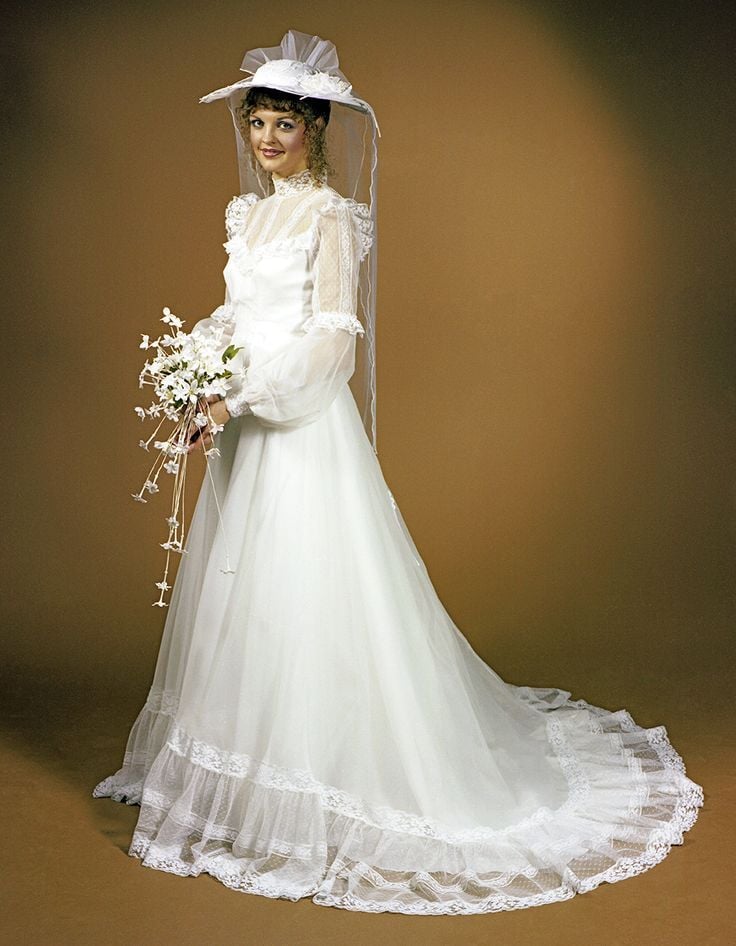
And then there is the wide-brimmed picture hat, veil and all, worn by a bride who clearly did not come to blend in. This pose and dress are just classic 1970s.
Watch out for: these are the showpieces, and they are not for the faint of heart. On the right bride, in the right old church, they are unforgettable.
The Hair Was Long, Center-Parted, and a Little Bit Disco
Finish the picture with the hair, because it dates a photo as fast as the dress does. Seventies brides wore it long and loose, parted dead center, with a soft flip at the ends or a curtain of bangs across the brow.
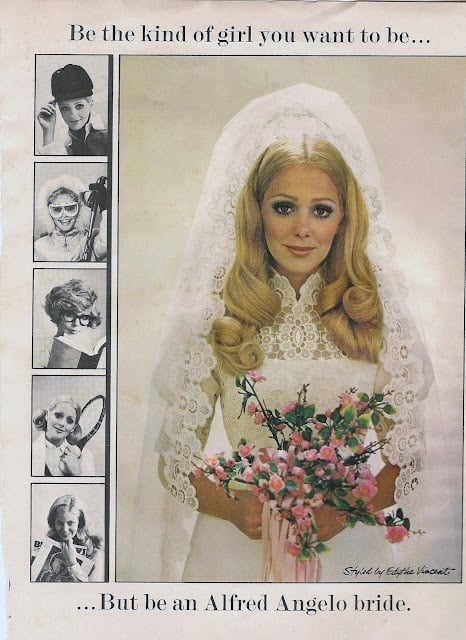
Alfred Angelo’s “Be the kind of girl…” campaign likely started a decades-long obsession with this entire look, hair included. Five little snapshots of a modern woman run down the side (riding, tennis, sunglasses) next to a bride in long flipped hair under a lace mantilla, with the tagline: “Be the kind of girl you want to be… But be an Alfred Angelo bride.”
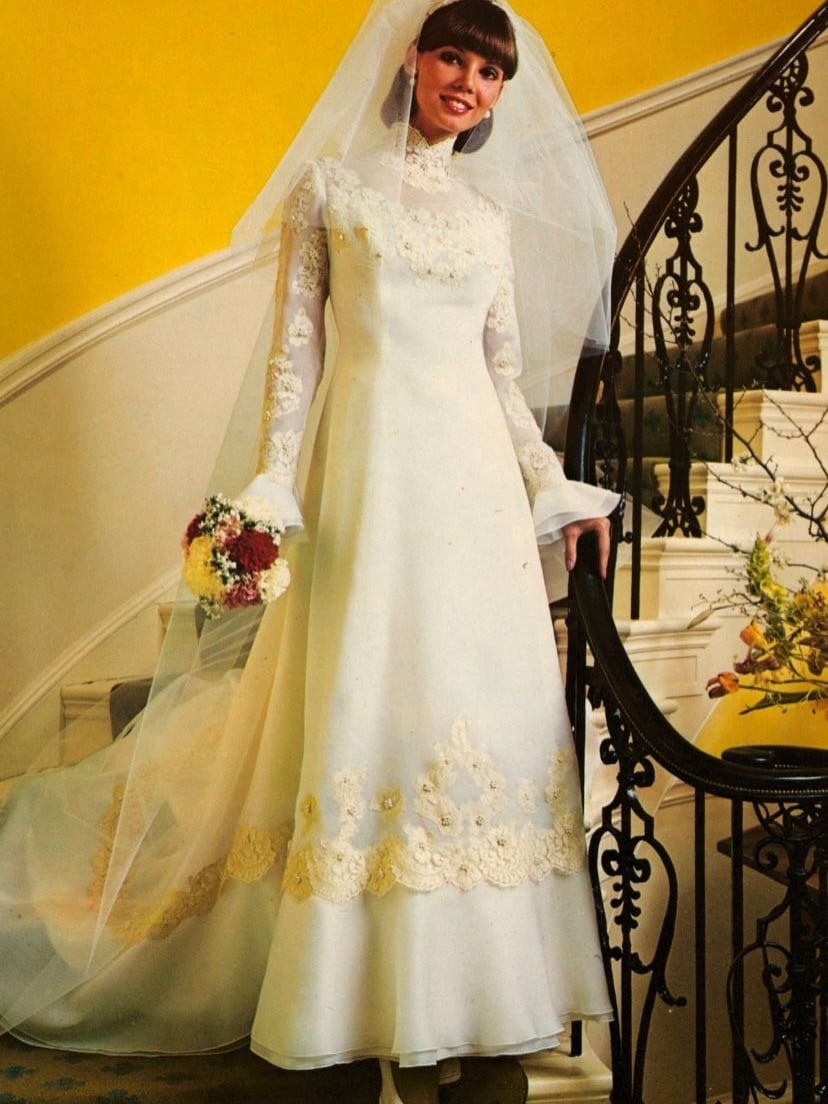
And then there are the bangs. Blunt straight across the forehead, gown to the floor, posed on a curving staircase in front of a sunny yellow wall. The dress is a lot, but at least her hair was cute! You could not be more 1974 if you tried.
Steal it: the center part and soft flip is easy to recreate, and it suits a modern gown as well as a vintage one. We have a whole gallery of wedding hairstyles if you need a starting point.
Would You Actually Wear It?
A lot of this is back already, only cut cleaner and styled looser. We keep seeing the bishop sleeve and the lace mantilla on brides who were not even born in the seventies, and we are into it. The hooded ruffle gown can stay in 1974, and that is okay too.
So if you found your mom’s gown in a garment bag, or you keep saving seventies brides to a Pinterest board, you’re in good company. Try it on. Take it to a tailor. A good seamstress can update the fit without losing what made you love it in the first place. And if you want more where this came from, we keep a running love letter to the old stuff in our vintage wedding dresses and vintage wedding ideas posts.
Worst case, you spend an afternoon in a lace cape and a picture hat. There are worse ways to spend a Saturday.
Some links in this post may be affiliate links, which means we may earn a small commission if you make a purchase through them. Thank you for your support!


My wedding dress in the 70s was inspired by Alfred Angelo. The fashion at that time had a lot of thought and style behind it as compared to today’s trends. So good to see these trends coming back to fashion.
Married in 1977. Loved my dress by Eve of Milady. Saw it in a bridal magazine and hunted till I found it at a small shop. Bishops sleeves ( but cuffs came to a point with buttons), check, high collar, check, Camelot cap, check . Epitome of a 1970’s bride and wouldn’t have it any other day. There was only one other dress I MIGHT have worn but never saw it in person. It was also an Eve of Milady and had 3 tiers of ruffles at he hem.
Its no wonder looking at these wedding dresses that I refused to wear one in 1975. I wanted to wear a short skirt/dress. Mother wanted long. I finally told her to pick a dress. She picked a long brown dress with white polka dots.
The Vogue pattern with the simple triangle scarf was my dream dress until I found a Priscilla of Boston original
Satin, lace, pearls and sequins, short sleeves and modified high neck. It was in a color called “candlelight “, a sort of soft ivory. I was very lucky that it was a remainder dress for $25.
My wedding dress was a simple eyelet with cap sleeves. I wish I could find another dress like that.
Thanks for this wonderful article. I loved the fashion trends in the 70s and this inspires me to style my wedding dress based on the 70s!