She raised him. She probably cried at the engagement announcement. She may have helped pay for the whole thing. And now, after months of planning, opinions, and navigating a role that nobody really defines clearly, the wedding day is finally here. The mother of the groom deserves to enjoy every minute of it.
But here’s the thing about wedding days: they’re emotional, they’re fast, and even the most well-meaning people can get tripped up by the moment. A comment that lands wrong. An outfit decision nobody ran by the bride. A toast that went five minutes longer than it should have. None of it is usually malicious — but some of it is absolutely memorable, and not in the good way.
This list isn’t a pile-on. Most mothers of the groom are genuinely wonderful, and the vast majority of the tension that shows up in wedding planning comes from unclear expectations, not bad intentions. So think of this as the cheat sheet: the specific things that have a way of going sideways on the actual day, and exactly how to avoid them. Whether you’re the MOG reading this yourself, or the bride quietly hoping someone will send it to her future mother-in-law, you’re in the right place.
1. Wear White, Ivory, Cream, or Anything Close
This one has been said so many times that it almost doesn’t need repeating — except it still happens. Every single wedding season. The rule is straightforward: white, ivory, cream, blush, and champagne are off the table unless the bride has specifically told you otherwise. That includes “it’s not really white, it’s more of an eggshell” and “it’s technically silver but it photographs light.” If there’s any question about whether a color is too close, the answer is to choose a different dress.
The good news is there are genuinely beautiful options in every other direction. Navy, dusty blue, sage, wine, emerald, rose, taupe — the range of what reads polished and wedding-appropriate is enormous. And if you’re not sure what palette works with the wedding colors, ask. Most brides are happy to share their color story and will appreciate being looped in rather than surprised at the altar.
Traditionally, the mother of the bride shops for her dress first and then lets the MOG know the general color and length so they can coordinate without matching. If you haven’t heard anything by the four-month mark, it’s completely fine to reach out and ask. There are incredible mother of the groom dresses across every budget and venue type — the only thing that should be off your list is white.
Watch out for: Matching the bridesmaids too closely. Coordinating with the wedding palette is lovely. Wearing the exact same color in the exact same silhouette as the bridal party is a different situation entirely — it can read as trying to blend in where you shouldn’t.
2. Give an Unsanctioned Toast
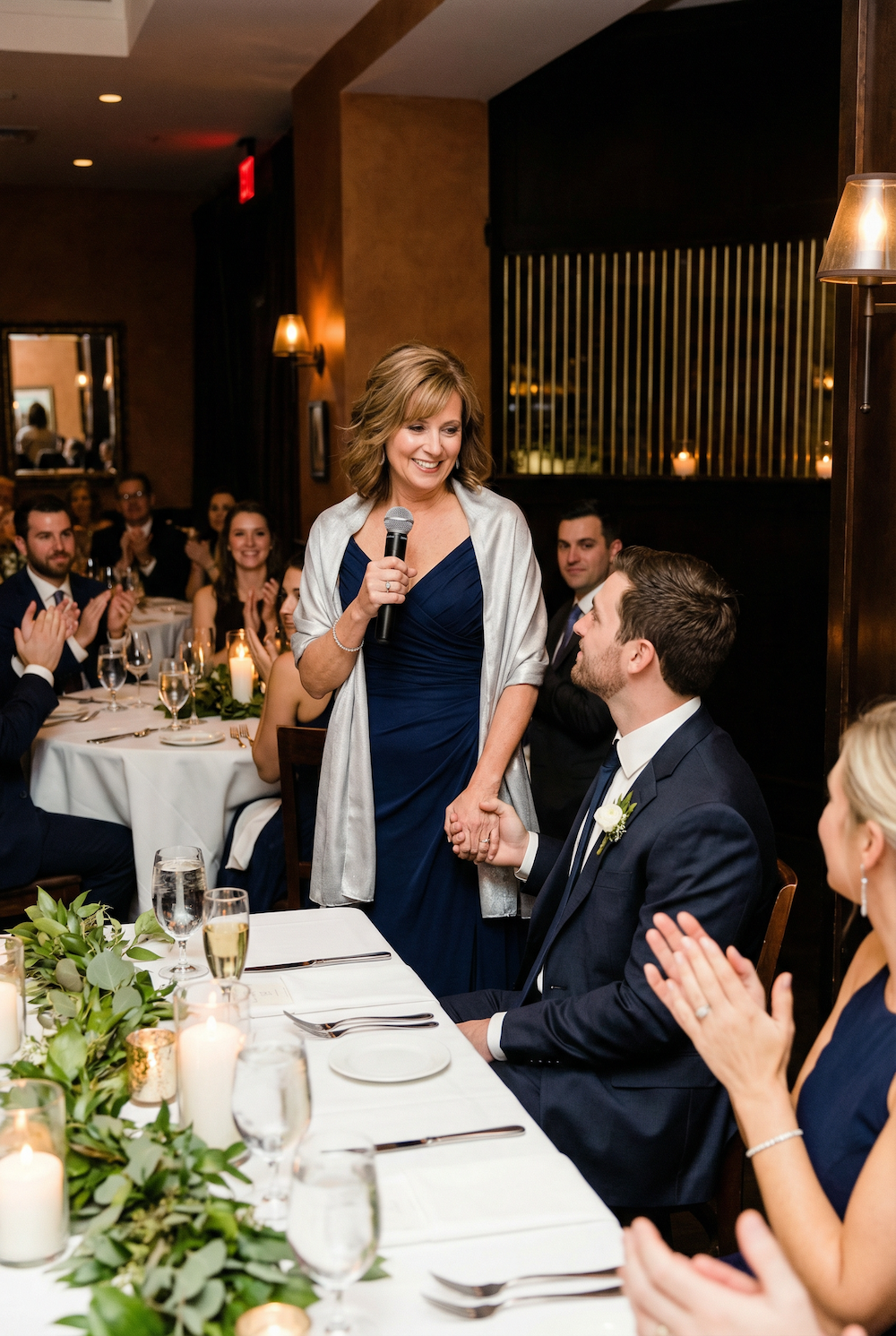
A heartfelt, well-timed speech from the mother of the groom can genuinely be one of the most moving moments of a reception. The problem is when it happens without warning, runs long, veers into territory the couple didn’t agree to, or takes the microphone at a moment that throws off the entire timeline.
If you want to speak at the wedding, ask ahead of time. That’s the whole rule. Get confirmation from the couple, find out when you’re slotted in, and keep it to three to five minutes maximum. Think about what you want to say and say that — warmly, specifically, without going off script into stories that make the bride uncomfortable or jokes that only land for half the room.
If the couple has decided to keep speeches tight (best man and maid of honor only), honor that decision gracefully. There are other ways to share how you feel: a handwritten note, a private moment before the ceremony, a beautiful toast at the rehearsal dinner where it’s entirely your territory to set the tone. The reception timeline is a careful thing, and a surprise grab for the microphone — even with the best intentions — can disrupt the whole flow of the evening.
Pro tip: The rehearsal dinner is traditionally hosted by the groom’s family, which means the MOG has a natural moment to speak there. If you have things you want to say, the rehearsal dinner is the perfect venue for them — more intimate, less pressure, and entirely appropriate for the groom’s family to take center stage.
3. Direct Vendors, Planners, or the Venue Staff
This one is subtle, but it causes real problems. The wedding day has a chain of command: the couple, then their planner or coordinator, then the vendors. The mother of the groom is not in that chain for operational decisions. Telling the florist to move the centerpieces, asking the DJ to play something that wasn’t on the approved list, redirecting where the photographer should be shooting — all of these cross a line, even if the intent is helpful.
Vendors take direction from whoever hired them. When a well-meaning family member starts issuing different instructions, it creates confusion, slows things down, and sometimes results in the couple getting something other than what they planned for. Your photographer is not going to stop shooting the ceremony to capture a candid you requested if it conflicts with the shot list the bride spent an hour crafting.
If something genuinely seems wrong — a vendor hasn’t arrived, a detail looks noticeably off — the right move is to flag it to the coordinator or the couple’s day-of point person, not to handle it yourself. That’s what the coordinator is there for. Trust the system the couple built.
Smart move: If the couple has asked you to take on a specific day-of responsibility (like collecting cards, distributing tips, or managing shuttle logistics for groom’s-side guests), get clear instructions ahead of time so you can execute your role without needing to improvise in the moment.
4. Make It About Your Grief (Out Loud)
Watching your son get married is emotional in a specific way that doesn’t get talked about enough. There’s joy in it, but there’s also a real sense of transition — your relationship with him is shifting, a new family unit is forming, and someone else is now his primary person. Those feelings are completely valid. They’re also not something to process loudly at his wedding.
Comments like “I’m losing my son,” “she’s stealing him away,” or “it’ll never be just the two of us again” — even said with a tearful smile — put a shadow over what should be an entirely joyful day. They also make the bride feel like a villain in a story she didn’t write. Whether these things are said directly to the groom, to guests, or even captured on a hot mic during a candid moment, they have a way of becoming the thing people remember.
The healthier frame: you’re not losing a son. You’re gaining a daughter-in-law and watching your kid choose his life. That’s the job of parenting done well. Lean into that story, especially in any remarks you make or moments you’re photographed in. The grief, if it’s real, belongs in a private conversation with a trusted friend — not in the cocktail hour.
Best for: Every MOG, but especially those navigating a complicated or emotionally layered relationship with their son. The day will go better — for everyone, including you — if you arrive having already done some of that emotional processing in advance.
5. Compete with the Mother of the Bride
This one plays out in a few different ways. It can be the dress that’s just a little more elaborate. The toast that runs slightly longer. The way a conversation keeps circling back to how much the groom’s family contributed, or how many people “our side” brought to the guest list. Competition between the two mothers is one of the most common sources of wedding day tension, and it almost always starts before the ceremony and escalates quietly throughout the day.
The mother of the bride traditionally has a slightly more visible role at a wedding — walking down the aisle last before the processional, being seated first, often appearing more prominently in the family photos. That’s just tradition, not a ranking of importance. The mother of the groom’s role is equally significant; it’s just expressed differently. Your son chose his partner. That relationship is what the day is actually celebrating, and both families are there to support it.
If you genuinely don’t know the mother of the bride well, the wedding day is a great opportunity to start. Being warm, gracious, and focused on celebrating the couple rather than quietly keeping score is both the right thing to do and — not unimportantly — exactly what your son will remember.
Watch out for: Coordinating your outfit directly against hers instead of complementing it. Ideally, the two mothers should communicate about colors and formality so neither accidentally clashes or matches too closely. Most MOB and MOG dresses are designed to work across roles — what matters is communication, not competition.
6. Offer Running Commentary on the Day’s Choices
The seating chart you disagree with. The menu that doesn’t include enough options. The ceremony that ran a little long, or the DJ who plays songs you’ve never heard. Wedding day is not the moment for any of these observations, even casually. Comments that seem offhand have a way of getting back to the couple, and on a day that’s already emotionally charged, “I would have done it differently” lands harder than you think it will.
This is especially true around the bride’s choices specifically — her dress, her flowers, her vows, the way she’s organized the reception. Anything that sounds even slightly critical of decisions she made is going to sting, regardless of how it was intended. The wedding day is genuinely not the time to relitigate any of the planning conversations that may not have gone your way.
The version of this that’s hardest to catch in yourself: the backhanded compliment. “The flowers are so interesting — I wouldn’t have thought of that” or “It’s not exactly what I pictured for him, but she looks happy” are still opinions. If in doubt, a genuine smile and “everything looks beautiful” is always the right answer.
Smart move: If there was something during the planning process that genuinely bothered you and you never got resolution on, let it go before the day arrives. Holding onto it through the ceremony and reception means you’ll be half-present for a day you can’t get back.
7. Monopolize the Groom’s Time
You will want moments with your son on his wedding day. That’s completely natural and completely reasonable. Just know that everyone else there loves him too — his new spouse most of all — and the day will move faster than you expect. The instinct to pull him aside for extended one-on-one time, or to hover during moments that are meant to be couple-focused, can create friction even when it comes from a genuine place.
There are designated moments in the timeline that belong to you: the mother-son dance, family portraits, the processional. These are your moments, and they are real and meaningful. Trust that they’re enough, and spend the rest of the reception being a gracious, present guest rather than engineering additional private time with him throughout the evening.
The best thing you can do on the day is make it easy for him. He’s managing a lot of moving parts, a lot of people, and a lot of emotion. A mother who is warm, grounded, and self-sufficient — who doesn’t need him to check in, doesn’t create situations he has to manage, and is visibly having a wonderful time — is genuinely one of the best gifts you can give him on his wedding day.
Best for: MOGs who have a very close relationship with their son and may not have spent much time with his partner yet. The wedding is actually a great day to invest in getting to know your daughter-in-law’s family — it pays dividends for years.
8. Show Up to Anything Late
If there are family portraits scheduled, be there. If the ceremony starts at 4:00, be seated by 3:45. If the processional requires you to be lined up at a specific time, know when that is and plan for it. The mother of the groom is not a background guest — she’s a named participant in several of the day’s most important moments, and missing them (or arriving to them flustered) affects everyone.
This is especially true for pre-ceremony family photos, which typically happen in a tight window and can’t be delayed without pushing the entire timeline back. Photographers build in buffer time, but not unlimited buffer time. If one family member is consistently late to the photo call, it means other people are standing around in formal attire waiting, which is nobody’s idea of a good pre-wedding experience.
Get a copy of the wedding day timeline in advance — the couple’s planner or coordinator should be distributing one to key family members — and treat it like a real schedule, not a rough outline. Knowing exactly when you need to be where eliminates the scramble.
Pro tip: Plan to arrive at every scheduled moment 10 to 15 minutes earlier than you need to. It gives you time to get oriented, touch up your look, and be calm rather than rushed. On a wedding day, calm is contagious in the best possible way.
9. Go Off-Script During the Processional or Ceremony
The processional has an order for a reason, and the ceremony has a structure the couple spent real time planning with their officiant. The mother of the groom’s role in the processional is usually to be escorted down the aisle early in the sequence — traditionally before the groom’s grandparents, or right after them, depending on the ceremony style. Once she’s seated, the processional moves forward. This is not a moment for improvisation.
Where this gets tricky: emotional responses that spill into the ceremony in disruptive ways. Audible sobbing that pulls focus. Standing to take photos during the vows when the couple asked for an unplugged ceremony. Leaning over to whisper to the person next to you throughout. These things seem small from the inside but register clearly to everyone around you — including, sometimes, the couple.
If the couple has asked for an unplugged ceremony, that applies to you too. Put the phone away. There will be a professional photographer capturing every moment. Your job in the ceremony is to be present and emotionally supportive, not to document.
Watch out for: Last-minute adjustments to your involvement that weren’t discussed ahead of time. If you want to be included in something specific — a reading, a walk down the aisle with your son, a moment in the ceremony program — bring it up during planning, not on the day of.
10. Make the Bride Feel Like a Guest at Her Own Wedding
This is the one that covers everything else. It shows up as prioritizing groom’s-side family for the best photo spots, centering groom’s-side traditions without acknowledging hers, treating the reception like a family reunion for your side of the guest list while the bride stands slightly apart from it, or simply directing most of your warmth and attention inward rather than outward.
The bride has spent months, sometimes years, imagining this day. She’s also been navigating your family’s dynamics, your opinions, and your expectations right alongside her own planning process. On the actual wedding day, what she needs from you is simple: warmth, graciousness, and the feeling that she is genuinely welcome in your family. Not just tolerated. Welcome.
That can look like a genuine hug before the ceremony. Introducing yourself warmly to her family members you haven’t met. Saying something specific and sincere about how happy you are for them both — not just for your son, but for her, and for the life they’re building. These gestures cost nothing and matter enormously. They’re also the things your son will carry with him long after the wedding itself is a distant memory.
Smart move: Before the wedding day, make one specific effort to connect with your daughter-in-law in a way that has nothing to do with planning logistics. A note, a phone call, a small gesture that says “I see you and I’m glad you’re joining our family.” It sets a tone that carries through everything else.
So, What Actually Matters?
The mother of the groom who has an incredible wedding day is not the one who managed every detail perfectly. She’s the one who showed up ready to celebrate, made the people around her feel valued, stayed in her lane, and let her son and his partner have exactly the day they planned. That’s it. That’s the whole role.
If you’re a bride reading this and navigating some complicated MOG dynamics, know that setting clear expectations early is genuinely the kindest thing you can do — for yourself and for her. Most tension comes from ambiguity, not malice. Give her a lane, communicate what you need, and let your partner lead his own family conversations. The wedding day is so much easier when those conversations have already happened.
Frequently Asked Questions
Can the mother of the groom give a speech at the wedding?
Yes, but only if the couple has agreed to it in advance. If you want to speak at the reception, ask the couple directly, find out when you’re slotted, and keep your remarks to three to five minutes. An unsanctioned grab for the mic — however heartfelt — can disrupt the timeline and catch the couple off guard. The rehearsal dinner, traditionally hosted by the groom’s family, is also a natural and appropriate place for the MOG to speak.
What colors should the mother of the groom avoid wearing?
White, ivory, cream, blush, and champagne are off limits unless the bride has specifically said otherwise. Beyond that, it’s also smart to coordinate with the mother of the bride so the two of you don’t clash or accidentally match. Most couples are happy to share their color palette — ask ahead of time rather than guessing.
What is the mother of the groom’s role in the processional?
Traditionally, the mother of the groom is escorted down the aisle near the beginning of the processional — typically after the grandparents and before the wedding party. She is seated on the right side of the ceremony (the groom’s side, in traditional Christian ceremonies). The exact order can vary based on family dynamics and ceremony style, so confirm with the couple or officiant ahead of time.
Is it okay for the mother of the groom to take photos during the ceremony?
If the couple has requested an unplugged ceremony, that applies to all guests — including family. Put the phone away and be present. There is a professional photographer capturing the day. If the ceremony is not unplugged, use your judgment: discreet, quiet phone photos from your seat are generally fine; standing up mid-ceremony to get a better angle is not.
Some links in this post may be affiliate links, which means we may earn a small commission if you make a purchase through them. Thank you for your support!