
You finish the catering tasting feeling great, and then the proposal hits your inbox the next day. Page two has a line for cake cutting. Another for “service charge.” A third for vendor meals at $89 a head. None of those numbers came up at the tasting, and you’re left wondering if this is just how weddings work or if you got the wedding version of a hospital bill.
Some of it is just how weddings work. A LOT of it is also negotiable, swappable, or skippable, which is the part nobody puts in the brochure. We love a transparent vendor (we really do!), and most planners will be the first to tell you the contract has slack in it. Asking “is this negotiable?” feels rude when you’re eight months in and in love with your venue, but it’s actually the smartest thing you can do.
Below are the 10 fees we see eat up budgets the most, with what to expect and exactly what to ask for. (For the full pricing breakdown across every category before any of these add-ons hit, our Smart Wedding Planner Guide has the data.)
1. The Cake-Cutting Fee
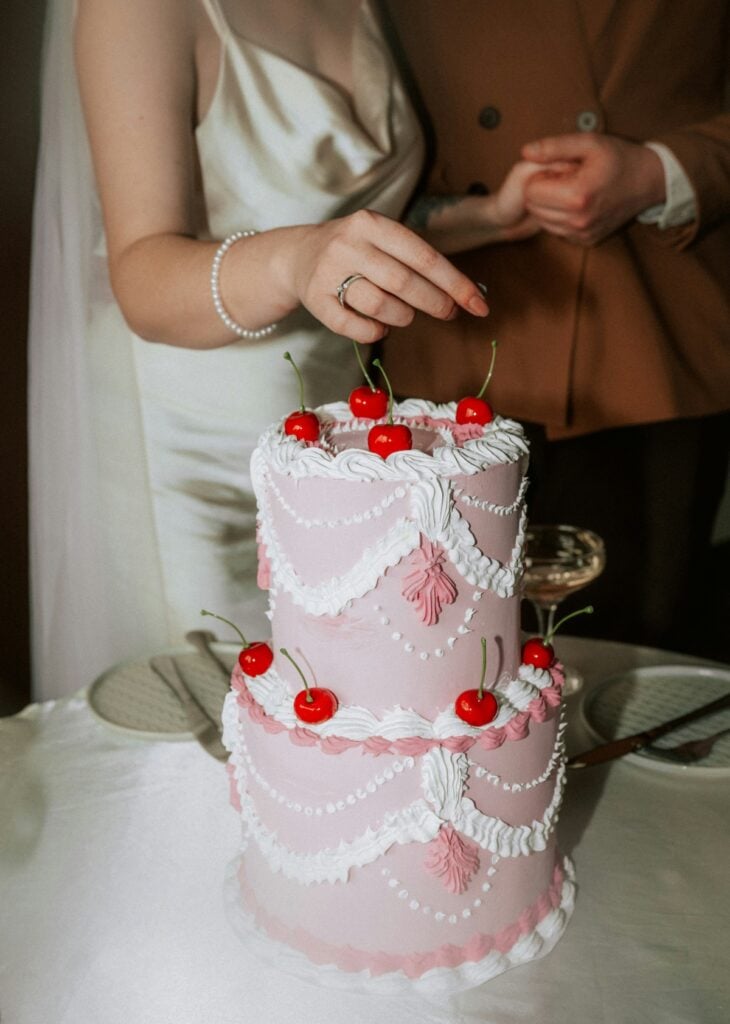
Your baker delivers and stages the cake. The venue staff cuts, plates, and runs it to tables. For that handoff, most full-service venues charge $2 to $10 per slice. On 150 guests, that’s $300 to $1,500 added on top of the cake you already paid a baker $1,200 to make.
Ask the venue to waive the fee, especially if you’ve already cleared their food and beverage minimum, or ask them to roll it into the per-person dinner rate so it’s not bolted on as a separate charge. If they won’t budge, swap your designer cake for a smaller display cake plus a “kitchen cake” (the same cake without the design work, sliced in the back) or a dessert table. Andrea Weithers of Sweet Details cake studio in Atlanta told us a kitchen cake genuinely starts saving you money once your guest count is 130 or more. Below that, just go bigger on the display cake itself.
Worth asking: “Is the cake-cutting fee waivable if we hit the F&B minimum?” Most contracts have wiggle here, especially mid-week or off-season.
2. “Corkage” on Alcohol You Were Told You Could Bring
Some venues let you BYO wine and spirits, then charge a corkage fee of $10 to $25 per bottle to actually serve it. On a 120-person wedding with a couple of glasses of wine each, that’s roughly 50 bottles, which works out to a $500 to $1,250 fee on top of the wine itself.
Sometimes the corkage math still pencils out. A $20 corkage on a $15 bottle of Costco bubbles is way cheaper than a $14 glass from the venue’s pour. Sometimes it doesn’t, and the venue is counting on you not running the numbers. Run them both ways before you sign. And if you do BYO, find a local distributor that buys back unopened bottles, so you’re not gambling on guest count.
Watch out for: venues that add a “wine handling” or “approval” fee on top of the corkage itself. Ask for the all-in BYO number in writing before you sign.
3. The “Service Charge” That Isn’t Gratuity
This is the fee that surprises the most couples. A 20% service charge gets added to your $25,000 catering bill (a $5,000 line item by itself), and then your venue manager mentions you should also tip the captain, the bartenders, and the floor staff at the end of the night. The service charge mostly goes to administrative costs and the house labor pool, not directly to the people serving your guests.
That double-billing is industry standard, and it’s also why your final number feels $7,000 higher than expected. As we lay out in our Smart Wedding Planner Guide, the catering “++” pricing on your contract means base price PLUS service charge PLUS tax. A lot of couples sit down at contract review unaware that an $85/pp dinner is actually a $115/pp dinner once you do the full math.
What to ask, in writing: “Does the service charge include gratuity for the staff? If not, what’s the tip pool, and can the service charge be reduced if we tip the team directly in cash that night?” Some venues will adjust the percentage if you commit to handling tips yourself.
If reading that last part made your stomach drop, take a beat and run your actual number through our budget tool. It pulls from real surveyed wedding spending so you can see where YOUR ceiling should sit before any of these line items get bolted on:
Are you overspending on your wedding? This 60-second quiz will tell you.
Most brides go into planning with a number in their head and no idea where it's actually going. Enter your budget and guest count, and get a clear picture of exactly where your money is at risk, what you're most likely to overspend on, and where you can cut without anyone noticing.
What matters most to you?
Every vendor will tell you: unless you have an unlimited budget, you HAVE to prioritize. Tell us what matters most to you so your results are specific to YOUR wedding — not some generic checklist.
Your budget has a blind spot.
What’s inside your results
📊Your budget score & #1 blind spot
⚠️Your biggest pressure point
💡Where you’re most likely to overspend & save
💰Your recommended budget breakdown
No spam. Unsubscribe any time.
4. Vendor Meals Billed at the Full Guest Rate
You’re paying $130 a head for a plated dinner. Your photographer, second shooter, videographer, planner, and DJ all need to eat on a long workday. The venue line-itemizes them at full guest pricing, and suddenly five vendor meals add up to $650.
Vendor meals are a real obligation (fed vendors do better work), but most catering contracts include a vendor-meal rate that’s significantly lower than the guest rate. Usually $25 to $45 per head for a sandwich, a salad, and a soft drink served during dinner. Ask for it specifically. If the venue says they only have full-rate meals, push back. Most kitchens will accommodate a vendor box, they just don’t volunteer it unless you ask.
Watch out for: doubled-up vendor meals when your DJ has a setup tech, your photographer brings an assistant for ceremony only, or your videographer leaves at first dance. Confirm vendor headcount the week of the wedding, not at booking.
5. The Florist’s “Setup and Strike” on Top of the Design Fee
Most florist proposals have one big number for design and arrangements, a separate delivery fee, and then a setup-and-strike charge of 20% to 30% of the design subtotal. On a $5,000 floral package, that’s another $1,000 to $1,500. The math is fair on the labor side: a crew has to drive the van, build the arch on-site, and come back at midnight to dismantle it. But you can shrink the bill.
The simplest play is to skip the strike on anything that doesn’t have to come down that night. Loose centerpieces, candles, and bud vases don’t need a midnight crew if your maid of honor takes them home in her car. The arch and the larger installations do. Ask your florist to break out which pieces drive the strike fee, then keep only the structural ones on the contract.
We love what Amy McCord Jones of Flower Moxie told us when we interviewed her: focus your floral budget on the loud moments (your bouquet, your altar) and let the rest of the room do its work with greenery and candles. Repurposing those ceremony florals to your reception space cuts both the design AND the setup cost almost in half.
Smart move: ask your venue what florals can stay staged from a previous wedding earlier that day. Some venues have an unspoken pass-along arrangement during peak season, especially for ceremony arches.
6. The DJ “Idle Hour” Charge During Dinner
Most DJ contracts bill for total event time, from setup arrival through load-out, which usually runs 8+ hours even when you only have four hours of actual dance music. That part is fair. What’s worth pushing back on is when a DJ wants their full hourly rate during dinner, when they’re either off the mic entirely or playing low background music a Spotify playlist could handle on its own.
Ask for a “dinner break” rate or a flat package that bundles the dinner hour at a reduced number. A lot of DJs offer it but only if you bring it up. Ian Gotler of RedShoe DJs (one of our favorite music vendors) also points out that finding a venue with house sound equipment can save you hundreds, since equipment rental is often half the line item on a music quote.
Skip it: the second-system upsell for cocktail hour. If your cocktail space is one room, or shares a wall with reception, the same speakers can usually cover both. Confirm with the DJ before they quote two systems.
7. Photographer Overtime in Full-Hour Blocks
Your photographer’s contract says 8 hours of coverage. Your last dance lands at 10:42, ten minutes past your end time. Most contracts bill overtime in full-hour blocks at $250 to $500 an hour, so those ten minutes cost the same as a full hour would.
The fix is one question, asked at booking: “Do you offer half-hour overtime, or a flat wrap-around rate?” About half of photographers do, but only if you bring it up before you sign. Asking at 9:55 PM the night of the wedding is too late.
It also helps to build your timeline backwards from your exit so you’re not burning paid hours on empty time at the front. Most photographers don’t need to shoot the entire two-hour getting-ready window. The right timeline (our Smart Wedding Planner Guide has a worksheet for this, courtesy of planner Brooke Avishay of Orange Blossom Special Events) saves more on overtime than any negotiation will.
Worth asking: “Can we add a 30-minute overtime slot at booking instead of paying for a full hour at the door?”
8. Stacked Rental Fees: Delivery, Setup, AND Labor
Three separate fees for the same chairs. Delivery brings them to the curb (usually $80 to $400, depending on time window). Setup arranges them at $1 to $4 per chair. Labor staffs the strike at the end of the night. On 150 chiavari chairs, that math gets ugly fast.
Maria Erickson of Walden venue and Plum & Ivy Events told us this is the single biggest place couples overspend at venues that don’t include rentals. Her advice: prioritize a venue that includes tables, chairs, linens, and serveware in the rental fee. If yours doesn’t, ask the rental company to bundle delivery and setup into one line item, and put the breakdown on your wedding party (or the venue’s late-night staff if they offer that as part of the room turn).
Skip it: the white-glove setup tier when your venue has staff who can place rentals as part of normal room turn. Ask your venue first what they’re already willing to do at no charge.
9. The Bustle as a Surprise Add-On at Alterations
Your dress fits beautifully. Your alterations bill comes in at $650, and then there’s a separate $200 charge for the bustle, quoted at the final fitting like it’s news. Bustles run $75 for a simple one-point American to $300 for a multi-point Austrian, and they’re absolutely something the seamstress should price at fitting one, not fitting three.
Ask for a written breakdown of every alteration line at your first fitting: hem, bustle, bra cups, side seams, any beadwork repair. If the seamstress quotes piece by piece as you go, you’ll always end up over budget. I always recommend bringing the shoes you’ll actually wear (with the heel height you’ve committed to) to that very first fitting too. We’ve seen too many brides re-hem because their flats arrived two weeks before the wedding and threw off the length.
What to ask, at fitting one: “Can I get the full alterations quote in writing today, including the bustle?”
10. The “Outside Vendor” Fee from Your Venue
Some venues charge $500 to $2,000 to bring in a caterer, planner, or photographer who isn’t on their preferred-vendor list. The fee covers nothing operational. It’s an incentive to keep you inside the venue’s network, and the network often pays the venue a referral kickback in return for steering business their way.
If you’ve fallen in love with a venue and it has an outside-vendor fee, you have a few moves. Ask if the fee can be waived when you book one of their preferred vendors for catering AND your favorite photographer separately (catering tends to be the locked-in category, photography rarely is). Ask if the fee scales down for vendors who’ve worked the venue before. And if you’re early in the search, factor the fee into your venue compare-and-contrast: a “cheaper” venue with a $1,500 outside-vendor fee plus a mandatory $25,000 catering minimum may not be cheaper at all.
Worth asking: “Which vendor categories does the outside-vendor fee apply to, and which are flexible?” Most venues have one or two flex categories they don’t advertise.
So, What Actually Matters?
You don’t have to fight every line item to come out ahead. Most couples who work through this list negotiate three or four of these and end up saving somewhere between $2,500 and $6,000 against their original quote. The two highest-ROI moves are pretty much always the catering service-charge conversation and the cake-cutting fee, partly because they happen at the venue (where the dollar amounts are biggest) and partly because the venue has the most leverage on you, so they’re more willing to bend.
The order of operations: read every contract twice before you sign, ask for any verbal promise in writing (Bob Schrader, the wedding contracts attorney we interviewed for our book, says misinterpretation of terms is what sends most disputes to litigation), and treat fee discussions as a normal part of booking, not an awkward favor you’re asking for. If you want a head start on what your real number should look like by category, our budget tool below pulls from actual surveyed wedding spending, not what venues print on their brochures:
Are you overspending on your wedding? This 60-second quiz will tell you.
Most brides go into planning with a number in their head and no idea where it's actually going. Enter your budget and guest count, and get a clear picture of exactly where your money is at risk, what you're most likely to overspend on, and where you can cut without anyone noticing.
What matters most to you?
Every vendor will tell you: unless you have an unlimited budget, you HAVE to prioritize. Tell us what matters most to you so your results are specific to YOUR wedding — not some generic checklist.
Your budget has a blind spot.
What’s inside your results
📊Your budget score & #1 blind spot
⚠️Your biggest pressure point
💡Where you’re most likely to overspend & save
💰Your recommended budget breakdown
No spam. Unsubscribe any time.
Wedding vendors are running businesses with real overhead, and most of them are small operators putting in long hours on your day. Asking what’s negotiable doesn’t make you cheap. It makes you a smart client, and the good ones will respect you more for it.
FAQ
Are wedding vendor fees actually negotiable?
More than most couples realize. Catering minimums, service charges, cake-cutting fees, vendor meals, and bundled rental upcharges all have built-in flexibility, especially for off-season dates, weekday weddings, and couples who’ve already hit the venue’s F&B minimum. The line items most likely to be locked are taxes, gratuities going directly to staff, and venue-mandated rentals that come with the space. Everything in between is fair to ask about.
What’s the biggest hidden wedding cost most couples miss?
The catering service charge plus tax stack. A $25,000 food and beverage quote routinely lands at $32,000+ once you add a 22% service charge and 8% tax, and the gratuity for the team usually sits on top of that as well. Always ask your venue for the all-in number with service charge AND tax before you compare quotes. Per The Knot’s 2026 Real Weddings Study, couples spent an average of $292 per guest in 2025, and most of that creep happens in this exact spot.
Should I tip on top of the venue’s service charge?
Usually yes, and we know that feels frustrating when you’ve already paid a 20%+ service charge. The reason: most service charges go to administrative costs and a general labor pool, not directly to the captain, bartenders, and waitstaff working your wedding. Ask your venue manager in writing what the service charge actually covers. If the answer is anything other than “tipped out to your specific service team,” plan to tip 15-20% of the pre-tax bar bill and $20-$30 per server, just like you would at any other event.
Some links in this post may be affiliate links, which means we may earn a small commission if you make a purchase through them. Thank you for your support!



I totally agree with you, Jean! I hope that does come through to couples, and I always try to stress that.
As someone who spent 27 years as a wedding planner, I think there’s an important distinction worth making.
There’s absolutely nothing wrong with asking questions about fees or asking whether something is negotiable. Couples should understand exactly what they’re paying for before signing a contract.
Where I think this article could use more nuance is that many of these aren’t “hidden” or unnecessary fees—they’re charges for legitimate services. Delivery, setup, teardown, travel, overtime, and vendor meals all represent real labor and business expenses. Likewise, a service charge is generally not the same thing as a gratuity, and it shouldn’t be presented as though venues are trying to mislead couples.
The best approach isn’t to assume every fee is something you shouldn’t have to pay. It’s to ask what the fee covers, whether there are alternatives, and whether there are options that better fit your budget. Most reputable wedding professionals are happy to explain their pricing when asked respectfully.
An informed conversation is almost always more productive than assuming a fee is simply a markup.