
Nobody walks down the aisle planning to make mistakes. You’ve read the blogs, followed the planners on Instagram, pinned 400 things to a board called “THE WEDDING” in all caps. You feel prepared. And honestly? You probably are — for the big stuff. It’s the medium-sized stuff that gets you. The decisions that felt fine in the moment but hit different six months later when you’re flipping through photos or replaying the day in your head.
The tricky part about wedding regrets is that most of them aren’t dramatic. It’s not “I married the wrong person.” It’s “I wish I hadn’t spent $4,000 on flowers nobody remembers” or “I should have told my mother-in-law no when it mattered.” Small choices that snowball. Budget lines that didn’t need to exist. Moments that got sacrificed for logistics.
We asked, we listened, and we compiled. These are the real mistakes brides say they’d undo if they could — not hypothetical warnings from a planning checklist, but actual regrets from actual weddings. Some will confirm what you already suspect. A few might save you thousands of dollars. And at least one will probably make you text your coordinator right now.
1. Skipping a Day-Of Coordinator
This is the single most common regret across the board, and it’s not even close. Brides who skip a day-of coordinator almost universally say the same thing afterward: “I didn’t think I needed one, and I was wrong.” The logic makes sense on paper — you’ve done all the planning, your venue has a contact person, your mom and maid of honor can handle things. But “handling things” on a wedding day means fielding vendor arrivals, managing timeline shifts, troubleshooting a missing boutonnière, and keeping the whole production on track. That’s a full-time job, and it shouldn’t belong to anyone who’s supposed to be enjoying the wedding.
A day-of coordinator (sometimes called a “month-of” coordinator, since they typically come on 4–6 weeks before the wedding) usually runs between $1,000 and $2,500. That’s less than most floral budgets and arguably more valuable than every single one of your centerpieces combined.
Smart move: If budget is truly tight, hire a coordinator for just the day itself. Even six hours of professional management on the wedding day is better than asking your maid of honor to do a job she’s not trained for while wearing heels and holding a bouquet.
2. Choosing the Dress for Photos Instead of Comfort
The cathedral train looked incredible in the bridal salon mirror. It looked incredible in the Pinterest photos that inspired it. It did not look incredible when you were trying to use a bathroom stall, walk across a gravel courtyard, or sit down to eat dinner without someone rearranging six feet of fabric behind you. Brides who chose their dress primarily for how it photographs often say they spent the entire day managing the gown instead of wearing it.
This doesn’t mean you should pick the most boring dress in the store. It means you should sit down in it, walk in it, hug someone in it, and raise your arms in it before you commit. If the dress requires a handler, factor that into your day — or consider whether a different silhouette gives you 90% of the look with twice the freedom.
Watch out for: Dresses that feel “manageable” when you’re standing still in a fitting room with two consultants adjusting everything. Wedding day movement is constant and unpredictable. If you can’t sit, eat, dance, and hug without assistance, that’s data worth listening to.
3. Spending Big on Things Guests Don’t Notice
Here’s a hard truth from nearly every post-wedding budget review: guests remember three things — the food, the music, and whether they had fun. That’s it. They do not remember your custom napkin monograms. They did not notice the $800 upgrade to garden roses over standard roses. The charger plates, the specialty linens, the hand-calligraphed escort cards — lovely in theory, invisible in practice.
This isn’t a blanket argument against beautiful details. If lush florals bring you genuine joy, spend the money. But be honest about who the spending is for. If it’s for you, great — own that. If it’s because you think guests will judge a wedding without charger plates, they absolutely will not. Redirect those dollars to the open bar, a better band, or late-night tacos, and your guests will talk about your wedding for years.
Pro tip: Before signing off on any décor upgrade, ask yourself: “Would I notice this at someone else’s wedding?” If the answer is no, that line item is a candidate for cutting.
4. Not Getting a Videographer
Photography captures moments. Video captures motion, sound, laughter, your dad’s voice cracking during his toast, the roar when your song comes on, the way your partner looked at you when you came down the aisle. Brides who skip videography to save money almost always say it’s the one budget cut they’d reverse. Photos are essential — but they’re silent, and weddings are anything but.
Full cinematic packages can run $3,000–$8,000+, which is a real chunk of budget. But a single-shooter videographer doing highlight coverage often comes in between $1,500 and $2,500. Some do ceremony-and-toasts-only packages for even less. There are also newer options like guest-perspective video apps and single-camera setups that capture raw footage without the cinematic edit.
Best for: Brides who are close to their families and know the toasts will be emotional. You can live without a cinematic drone shot of your venue. You cannot recreate your grandmother giving a blessing.
5. Inviting People Out of Obligation
Every obligation invite costs you somewhere between $150 and $300, depending on your per-head catering costs. That means the table of eight coworkers you felt weird not inviting? That’s potentially $2,400 spent on people you eat lunch with occasionally. Your parents’ neighbors who you haven’t spoken to since high school? Another $600. These numbers add up fast, and the regret isn’t just financial — it’s spatial. Those seats could have gone to people you actually wanted there.
Setting boundaries on the guest list is uncomfortable, especially when parents are contributing financially and feel entitled to additions. But it’s one of the few wedding decisions with a direct, measurable impact on your budget, your venue options, and the overall vibe of the day. A 100-person wedding feels different than a 180-person wedding, and not just in cost.
Smart move: Create your list in tiers. Tier 1 is non-negotiable — immediate family, closest friends, the people who’d be hurt not to come. Tier 2 gets invited if Tier 1 RSVPs leave room. Tier 3 is the “would be nice” list. If parents push for additions, give them a set number of seats and let them allocate.
6. Over-Scheduling the Timeline
On paper, the timeline looks tight but doable. Ceremony ends at 4:30, family photos at 4:35, bridal party photos at 5:00, cocktail hour at 5:15, grand entrance at 6:00, first dance at 6:05, dinner at 6:20, toasts at 7:00, cake at 7:30, dancing at 8:00. In reality, your ceremony ran 10 minutes long, family photos took 30 minutes instead of 20 because Uncle Steve disappeared, and now everything is stacked on top of itself for the rest of the night.
Wedding timelines need buffer. Not five-minute buffers — real ones. Build 15–20 minutes of cushion between every major block. It feels wasteful during planning, but on the day, those buffers are the difference between a bride who’s relaxed and a bride who’s being rushed through every moment by a stressed coordinator with a walkie-talkie.
Here’s how to make a wedding timeline that works.
Pro tip: The biggest time thief is always family formal photos. Build 30–40 minutes for these, even if your photographer says 20. Someone will be in the bathroom. Someone will need a drink. Someone won’t know they’re supposed to be there. Plan for it.
7. Letting Family Opinions Drive Major Decisions
There’s a difference between including your family in wedding planning and letting them run it. That line gets blurred quickly — especially when parents are writing checks. Brides who let a parent’s strong opinions override their own on venues, guest lists, or ceremony style tend to feel a quiet resentment that surfaces after the day is over. It’s hard to look back at your wedding with full joy when key elements were someone else’s vision.
This doesn’t mean ignoring input or starting fights over napkin colors. It means identifying the 3–4 decisions that matter most to you and holding firm on those. Let the rest be collaborative. If your mom is passionate about the rehearsal dinner venue, let her have it. But if you wanted an intimate ceremony and ended up with 200 guests because your father-in-law “couldn’t possibly not invite” his entire golf club, that’s a boundary that needed to exist earlier.
Watch out for: The slow creep of “suggestions” that become expectations. A family member saying “wouldn’t it be nice if…” three times becomes “I thought we agreed on…” by the fourth. Name your non-negotiables early and communicate them clearly.
8. DIY-ing More Than You Can Handle
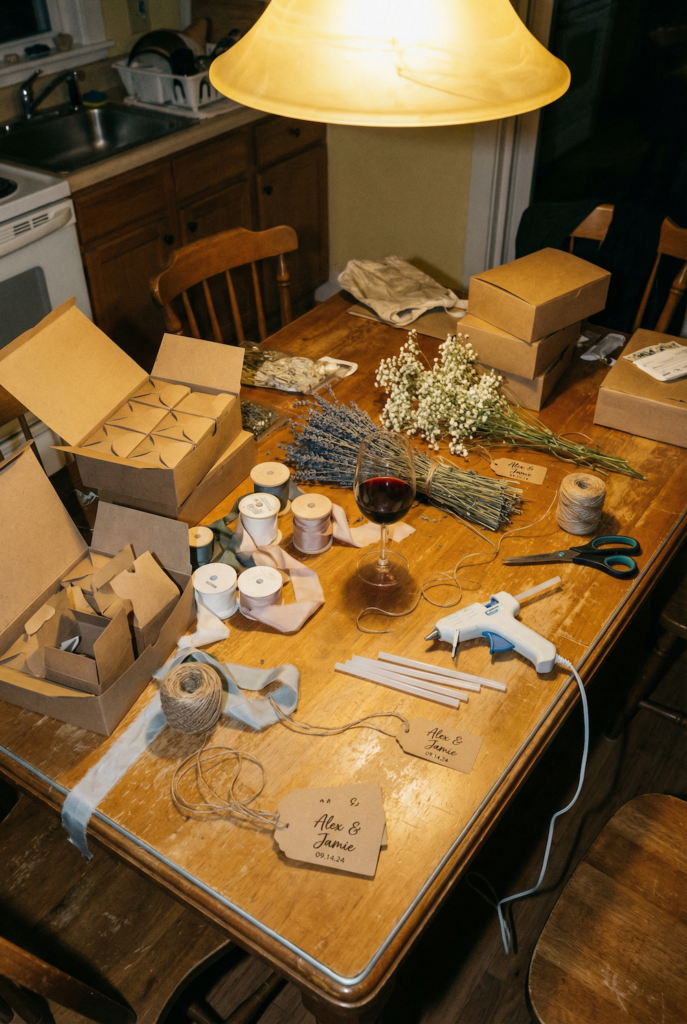
DIY weddings can be beautiful. DIY weddings can also result in a bride hot-gluing centerpieces at 1 AM the night before her wedding while crying into a glass of wine. The problem isn’t the concept — it’s the scope. One or two DIY projects (welcome sign, favor bags, a signature cocktail station) are manageable. Eight DIY projects involving different materials, drying times, and assembly teams are a second job you didn’t budget time for.
Before committing to any DIY element, do a realistic time audit. Not “how long does the tutorial say this takes?” but “how long will this take me, doing it for the first time, times the quantity I need, with materials I have to source and store?” If the honest answer eats more than two weekends, it’s cheaper in stress (and often in dollars) to outsource it.
Smart move: Pick one DIY project that’s meaningful to you and do it well. Outsource or simplify everything else. The bride who hand-lettered her own vow books? Lovely. The bride who hand-lettered 150 place cards, assembled 150 favor boxes, and built her own ceremony arch? Exhausted before the wedding started.
9. Not Breaking In Their Shoes
It’s such a small thing. It takes maybe three evenings of wearing them around the house. And yet, a staggering number of brides put on brand-new shoes for the first time on their wedding day and spend the reception with bloody heels and blisters forming under every strap. By the first dance, you’re either grimacing or barefoot — and while barefoot bride photos can be cute, it’s less cute when it’s because you’re in actual pain.
Wear your wedding shoes on carpet at home for at least a week before the wedding. Carpet because you can still return them if they’re not right. Wear them for at least an hour at a time. If they’re still uncomfortable after a week of breaking in, they’re the wrong shoes — switch to something else or invest in insoles designed for heels.
Pro tip: Bring a pair of comfortable flats or stylish sneakers to the reception regardless. Even if your heels feel fine at 6 PM, they won’t at 11 PM. Tuck them under the sweetheart table so they’re there when you need them.
10. Writing Vows the Night Before
You told yourself you’d start early. You meant to. Then life happened and suddenly it’s Friday night, the rehearsal dinner just ended, and you’re sitting on a hotel bed trying to summarize your entire relationship in 90 seconds while your bridesmaids are texting about brunch plans. The vows you write under those conditions will be fine. But “fine” is a sad word for the most important thing you’ll say out loud that year.
Start writing at least three weeks before the wedding. Not polishing — just getting words on paper. Write too much first. Write the sappy stuff, the funny stuff, the inside jokes, the real promises. Then edit it down over the following weeks. By the wedding day, you should be rehearsing, not drafting.
How to write vows that won’t leave a dry eye in the room!
Watch out for: Vows that are all jokes or all tears. The best ones have both. And agree with your partner on a rough length — nothing is more awkward than one person delivering a two-minute heartfelt speech and the other reading a single paragraph off their phone.
11. Ignoring the Weather Backup Plan
Outdoor weddings are gorgeous. They’re also at the complete mercy of forces you cannot control, negotiate with, or manifest away. Brides who don’t have a real rain plan — not “we’ll figure it out” or “the venue has an indoor option” that they’ve never actually seen set up — end up making panicked decisions at 7 AM on their wedding day while checking radar apps in their hotel robe.
If your ceremony or reception is outdoors, your Plan B needs to be fully planned, not just theoretically possible. That means walking the indoor backup space, confirming it fits your guest count, knowing how décor translates, and having your coordinator prepared to execute the switch. Treat Plan B like it’s the real plan that you hope you don’t need.
Best for: Every single outdoor wedding, regardless of the forecast. Weather apps are wrong constantly. A “10% chance of rain” has ruined more outdoor ceremonies than anyone wants to admit.
12. Skimping on Photography Hours
Booking your photographer for six hours seems like plenty. It’s not. Six hours covers getting ready, the ceremony, and maybe cocktail hour — which means your photographer is packing up right when the reception gets good. The dance floor moments, the late-night pizza, the sparkler exit, your grandmother doing the electric slide — gone. You saved $500 on those extra hours and lost photos you would have looked at for the rest of your life.
Most wedding photographers recommend 8–10 hours of coverage for a full wedding day. If your budget can’t stretch that far, prioritize the back end — the reception and dancing — over an extra hour of getting-ready shots. Your bridesmaids’ iPhones can handle the hair and makeup moments. Only a professional can capture a dark dance floor at 10 PM.
Smart move: Ask your photographer about adding a second shooter for just the reception portion. It’s usually less expensive than extending the lead photographer’s hours and gives you coverage of both the dance floor and the candid guest moments simultaneously.
13. Forgetting to Feed the Vendors
Your photographer has been on their feet since noon. Your DJ has been setting up for two hours. Your coordinator hasn’t sat down since Tuesday. These people are working an 8–12 hour day at your wedding, and if you haven’t arranged for them to eat, they’re running on granola bars and willpower. A hungry photographer at hour nine isn’t going to deliver the same energy as one who got a hot meal during dinner.
Most catering contracts include vendor meals at a lower per-head rate than guest meals — usually $25–$50 per plate. Confirm with your caterer how many vendor meals you need (count your photographer, second shooter, videographer, DJ, coordinator, and band members) and make sure there’s a designated spot for them to eat, even if it’s a back room or a staff table.
Pro tip: Feed your vendors the same food you’re serving guests, not a separate “staff menu.” It costs marginally more and the goodwill is worth it. Happy vendors perform better — it’s that simple.
14. Not Doing a First Look
The “first look” debate has strong opinions on both sides, and there’s no objectively right answer. But here’s what brides who skipped it consistently say: they wish they’d had a private, quiet moment with their partner before the ceremony instead of seeing each other for the first time with 150 people watching. The aisle reveal is beautiful — but it’s also high-pressure, public, and over in about 20 seconds.
A first look gives you 10–15 minutes of genuine reaction, real conversation, and intimate photos without an audience. It also has a massive logistical benefit: you can knock out all your couple portraits and most bridal party photos before the ceremony, which frees up your cocktail hour to actually attend your own cocktail hour instead of disappearing for 45 minutes of photos while your guests drink without you.
Watch out for: People who tell you a first look “ruins the moment” at the altar. It doesn’t. Every groom who’s done a first look still tears up at the aisle. You don’t get less emotional because you saw each other an hour earlier — you just get the emotion twice.
15. Neglecting the Guest Experience
It’s your day — that’s true. But your guests drove hours, bought flights, booked hotels, found outfits, bought gifts, and rearranged their weekends to be there. Brides who focus exclusively on “my vision” without thinking about whether guests are comfortable, fed, entertained, and informed tend to hear about it later — or worse, see it in the form of an early mass exodus.
Guest experience isn’t about being a servant to your crowd. It’s about basics: Is there enough seating? Is the cocktail hour long enough but not too long? Is there signage so people know where to go? Are there options for non-drinkers? Is the timeline clear? Is there shade or heating depending on the season? A ten-minute walk-through of the day from a guest’s perspective catches most of these gaps before they become problems.
Smart move: Ask one brutally honest friend to review your timeline and venue setup from a guest perspective. Not your most supportive friend — the one who’ll say “people are going to be standing in the sun for 40 minutes with no water, and that’s a problem.”
16. Not Preserving the Dress
After the wedding, your dress goes one of two places: into a preservation box within a few weeks, or onto a hanger in the back of your closet where it slowly yellows and absorbs the faint smell of storage for the next decade. Brides who wait more than a month to preserve their gown often find that stains have set — wine, makeup, grass, sweat — in ways that professional cleaning can’t fully reverse.
Wedding dress preservation typically costs $200–$400 and includes professional cleaning, treatment of any stains, and acid-free packaging designed to keep the fabric intact for decades. Whether you plan to keep it as an heirloom, donate it, or sell it later, preservation protects the option. Shoving it in a garment bag does not.
Best for: Every bride, but especially anyone with a gown that cost more than $1,000 or has sentimental value beyond the wedding day. Spending $300 to protect a $3,000 dress is just math.
17. Not Being Present for Their Own Wedding
This is the meta-regret — the one that encompasses all the others. Brides who spend the entire wedding managing, worrying, fixing, checking, and hosting consistently say the same thing afterward: “It went by so fast and I barely remember it.” Not because the day was short, but because they were never fully in it. They were in coordinator mode, in hostess mode, in problem-solving mode — every mode except “this is the happiest day of my life and I’m going to feel it.”
The antidote is a combination of everything on this list: hiring help so you’re not managing logistics, setting boundaries so you’re not people-pleasing, building buffer time so you’re not rushing, and giving yourself permission to let go of perfection. The flowers might be slightly wrong. The timeline will shift. Someone will say something awkward during a toast. None of that matters as much as you being present, laughing, dancing, and actually feeling your wedding while it’s happening.
Pro tip: Choose a “trigger phrase” with your partner — something simple like “we’re here.” When one of you notices the other spiraling into planning mode, say the phrase. It sounds silly. It works.
The Bottom Line
Wedding regrets rarely come from the things that went wrong — they come from the things you could have prevented with a little more honesty, a little less people-pleasing, and a slightly different allocation of time and money. You can’t control the weather, the DJ’s taste in transitions, or whether your uncle makes an inappropriate toast. But you can control where your budget goes, how your time is protected, and whether you show up to your own wedding as a guest or as an unpaid event manager.
Read this list again a month before your wedding. Show it to your partner, your coordinator, and your maid of honor. Cross off the ones you’ve already handled and flag the ones that need attention. Your wedding doesn’t need to be perfect — it just needs to be yours, and you need to actually be there for it.
FAQs
What is the most common wedding regret brides have?
The most frequently cited regret is not hiring a day-of coordinator. Brides who skip this role almost universally wish they hadn’t, because they end up managing vendor logistics, timeline issues, and last-minute problems themselves instead of enjoying the day. The second most common regret is not getting a videographer — photos are essential, but they can’t capture the sound of a toast or the energy of a dance floor.
What do brides wish they had spent less money on?
Décor details that guests don’t notice top the list: specialty linens, custom stationery upgrades, elaborate centerpiece designs, charger plates, and favor packaging. The consistent advice from married brides is to redirect that money toward food, music, and bar quality — the three things guests actually remember and talk about after the wedding.
Is it worth doing a first look before the wedding ceremony?
For most couples, yes. A first look gives you a private, emotional moment without 150 people watching, and it has a major logistical advantage: you can complete most of your couple and bridal party portraits before the ceremony, freeing your cocktail hour so you can actually attend it. Grooms who do a first look still have genuine emotional reactions during the aisle walk — the moment isn’t diminished by having seen each other earlier.
How far in advance should I write my wedding vows?
Start at least three weeks before the wedding. Spend the first week getting everything on paper without editing — memories, promises, inside jokes, the real reasons you’re choosing this person. Spend the next two weeks editing, refining, and practicing out loud. By the wedding day, you should be rehearsing delivery, not writing content. Also agree with your partner on approximate length so your vows feel balanced.
How many hours of photography coverage do I need for my wedding?
Most photographers recommend 8–10 hours for full wedding day coverage, from getting ready through the reception and exit. Six hours — a common budget-friendly package — typically cuts off right when the reception gets interesting. If you need to trim costs, keep the later hours and skip the extra getting-ready coverage, since those moments can be captured well enough on smartphones. The dance floor and late-night candids are what only a professional can capture properly.
Should I feed my wedding vendors a meal?
Yes, always. Your photographer, DJ, videographer, coordinator, and band members are working 8–12 hour days at your wedding. Most catering contracts offer vendor meals at a reduced rate of $25–$50 per plate. Serve them the same food your guests are eating — it costs slightly more than a separate staff menu but ensures your vendors stay energized and performing well through the end of the night.
Some links in this post may be affiliate links, which means we may earn a small commission if you make a purchase through them. Thank you for your support!






Don’t forget – get a wedding officiant (the one that performs the ceremony and makes the marriage legal) who listens to you, the couple, and creates a ceremony that YOU want, whether it’s short or long, civil or religious! You should find an officiant wherever you are who will work with you to create a ceremony that you WILL remember, your guests will remember, and if they’re really a professional, you’ll receive a copy of the ceremony so that you can refer to it years later and reminisce on what was said as you were joined together.
Here’s one thing brides should regret but probably won’t: making your wedding day a vulgar ego trip instead of a meaningful life changing ceremony. $$$$ for a wedding day coordinator? Puhleeze, get over yourself, Princess.