You hired the venue, booked the vendors, and color-coded your planning spreadsheet. You feel like you have it handled. Then, three weeks before your wedding, you find out your reception ends at 10 p.m. because of a noise ordinance your venue mentioned once in paragraph nine of your contract. That’s the thing about wedding planning – the stuff that derails you isn’t usually the big, obvious stuff. It’s the fine print, the assumptions, and the gaps between what vendors promise and what actually happens on the day.
This list is the conversation your wedding planner should have had with you at the very first meeting. Some of these are contract details, some are logistics, and some are just things nobody thinks to ask until it’s too late. Either way, consider this your warning – specific, practical, and in time to actually do something about it.
Your Venue’s Noise Curfew Can End Your Reception Early

Most venue contracts include a noise curfew, and most brides don’t notice it until they’re mid-planning. This isn’t just about volume – it often means music must stop completely by a specific time, sometimes as early as 9 or 10 p.m.
Before you finalize your timeline, pull out your venue contract and look for language around “music,” “amplified sound,” or “local ordinance.” Ask directly: what happens if the DJ is still playing at curfew? Is there a penalty?
Some venues can apply for noise variance permits for an additional fee, which can buy you an extra hour. Others are locked in by city ordinance and there is simply no workaround – what you signed is what you get.
Watch out for: Indoor-outdoor hybrid venues, which often have stricter rules for outdoor speakers even if the indoor space runs later. Confirm each area separately.
Ask the Caterer Who Handles Dietary Allergies On-Site

“We accommodate dietary restrictions” is not the same as “we have a protocol for serious food allergies.” These are two very different things, and conflating them can have real consequences on your wedding day.
Ask your caterer specifically: Is there a separate prep area for allergen-free meals? Who is responsible for tracking which guest gets which plate? Is the staff briefed on cross-contamination risks for guests with severe allergies like tree nuts or shellfish?
Get the answers in writing – not because you’re planning to sue anyone, but because a written policy means someone has actually thought it through. A caterer who hesitates at these questions is telling you something important.
Pro tip: Collect dietary information directly from guests on your RSVP form, then send that list to your caterer at least three weeks before the wedding – not the week of.
Outdoor Ceremonies Need a Signed Backup Venue Contract

A verbal promise that “we’ll move things inside if it rains” is not a plan. If your ceremony is outdoors, you need a confirmed, contracted indoor backup space – full stop. Assumptions about this have ruined more than a few weddings.
When you book an outdoor space, ask immediately: Is there an indoor option on the same property? What triggers the decision to move – who makes the call, and by what time? Get those answers added as a clause in your venue contract, not just an email exchange.
If the venue has no indoor option, you need to either rent a tent (budget $1,500 to $5,000+ depending on size and region) or contract a separate nearby space. Both options require booking well in advance, not the week before.
Smart move: Set a weather decision deadline of 48 to 72 hours before the wedding so vendors, guests, and your setup crew all have enough time to adjust.
Your Florist’s Delivery Window May Conflict With Setup

Most florists deliver within a two-to-three hour window, and they will not wait around while you sort out a venue conflict. If your venue isn’t ready for florals when the florist arrives, you have a problem – and it’s yours to solve, not theirs.
Confirm your florist’s exact delivery window and cross-reference it with your venue’s setup access time. Ask the venue: When is the earliest outside vendors can enter? Then confirm with your florist: Can you deliver within that window, and what happens if the venue isn’t ready?
Also clarify where florals go first – bridal suite, ceremony space, or reception tables. If your florist is handling all three, that takes longer than brides usually estimate. Build at least 90 minutes of buffer between delivery and your first ceremony photo.
Best for: Brides using large floral installations or arches – these take significantly longer to place and arrange, so your florist’s team needs venue access even earlier than standard delivery.
Most Venues Don’t Provide a Day-Of Coordinator

A venue coordinator and a day-of wedding coordinator are not the same person. The venue coordinator’s job is to protect the venue – making sure vendor rules are followed, the space is used correctly, and things wrap on time. Your day is not their priority. You are.
A day-of coordinator – sometimes called a wedding manager – works for you. They wrangle vendors, manage your timeline, cue the music, handle the seating chart chaos, and make sure your mom doesn’t start directing the photographer. They typically cost $800 to $2,500 depending on your market and how many hours they cover.
If your venue implies a coordinator is included, ask specifically: Will this person be managing my vendor timeline, or managing venue operations? The answer will tell you exactly what you’re getting.
Watch out for: Venues that list “event coordinator” as an amenity but mean someone who checks in your vendors at the door and disappears. That’s not the same thing.
Weather Insurance Exists and You Should Probably Buy It

Wedding insurance – including weather-specific coverage – is one of the most underused tools in wedding planning, and one of the cheapest relative to what it protects. A policy that covers weather-related venue cancellations or vendor no-shows typically runs $150 to $500 depending on your total wedding budget.
Look for policies through providers like Wedsure, Markel, or Travelers. Coverage varies, so read what’s actually included: Does it cover vendor cancellation? Extreme weather that prevents guests from traveling? Venue closure? Some policies require purchase at least 14 days before the wedding, so don’t wait.
This isn’t about being pessimistic – it’s about the same logic that makes you buy car insurance before you need it. One vendor cancellation the week of your wedding can cost you $2,000 to $5,000 to replace last-minute.
Smart move: Buy wedding insurance within 30 days of putting down your first major deposit. The earlier you buy, the broader your coverage window typically is.
Your DJ Needs More Time to Load In Than You Think

A DJ doesn’t just show up with a laptop and plug in. A full DJ setup – speakers, subwoofers, lighting rigs, cables, mixers – can take 90 minutes to two hours to load in and soundcheck. If your venue gives them one hour before guests arrive, that’s not enough.
When you book your DJ, ask: How much load-in time do you need, and what does the venue need to provide in terms of power access and elevator availability? Then confirm with your venue that this time is actually available and that the space will be cleared for them to work.
A DJ who has to rush setup will either skip soundcheck (meaning audio problems during your first dance) or start later than planned (meaning dead air while guests wait). Neither is a good option.
Pro tip: If your reception and ceremony are in the same space with a cocktail-hour flip, your DJ may need to set up in a staging area first. Confirm the logistics of that flip well before the wedding day.
Ask About the Vendor Meal Policy Before You Sign

Most vendors who work six or more hours at your wedding – photographers, videographers, DJs, coordinators – expect a meal. Many venue contracts specify whether vendor meals are included in your catering count or need to be added separately, and if you don’t ask, you may get a surprise invoice or hungry vendors eating off your cocktail hour plates.
Ask your caterer: Are vendor meals included in the per-head cost, or are they a separate line item? What are vendors served – the same meal, or a separate vendor meal? When and where do they eat? Vendors should be fed during dinner service so they are back and ready for dancing and toasts.
Skipping vendor meals to save money is one of those choices that tends to backfire. A photographer who hasn’t eaten since noon will not be performing their best at hour eight of your wedding.
Best for: Couples with five or more vendors working the full day – that’s a real cost to plan for, typically $25 to $75 per vendor meal depending on your caterer.
Guest Count Changes After the Deadline Cost Real Money

Caterers, venues, and rental companies all have a “final guest count” deadline – usually 10 to 14 days before your wedding. After that date, you are almost always locked into the number you gave them, even if three people cancel the week of the wedding.
Understand what your contracts say about this before you set your RSVP deadline. Your RSVP deadline should be at least two weeks before your vendor count deadline, so you have time to chase non-responders and finalize your number with confidence. Setting your RSVP deadline the same week as your caterer’s deadline is a setup for chaos.
Adding guests after the deadline – if it’s even allowed – typically costs a premium, sometimes 20 to 30% more per head than your original per-person rate. Removing guests usually doesn’t result in a refund.
Watch out for: Venues that charge for your contracted minimum regardless of attendance. If you guaranteed 150 and 120 show up, you may owe for 150. That clause is almost always in the contract.
The Bridal Suite May Only Be Yours for Two Hours

Many venues advertise a bridal suite as an amenity without specifying that your access to it is limited to a window – often just two hours before the ceremony. If your hair and makeup team needs four hours (which is common for a bride plus two bridesmaids), that math does not work.
Ask the venue directly: When does bridal suite access begin, and when must we vacate? Is access included in the rental fee, or is there an additional hourly charge? Can we access it the night before for setup? Some venues charge $100 to $300 per hour for extended access – others will simply say no.
If the suite timeline doesn’t work, you may need to start getting ready at a hotel or elsewhere and arrive at the venue already mostly done. That’s a valid option – just plan for it intentionally rather than discovering the conflict the morning of.
Smart move: Book a hotel room near the venue for the morning of the wedding. It gives your team a guaranteed, flexible space to work in without racing a venue clock.
Confirm Who Breaks Down the Décor at Night’s End
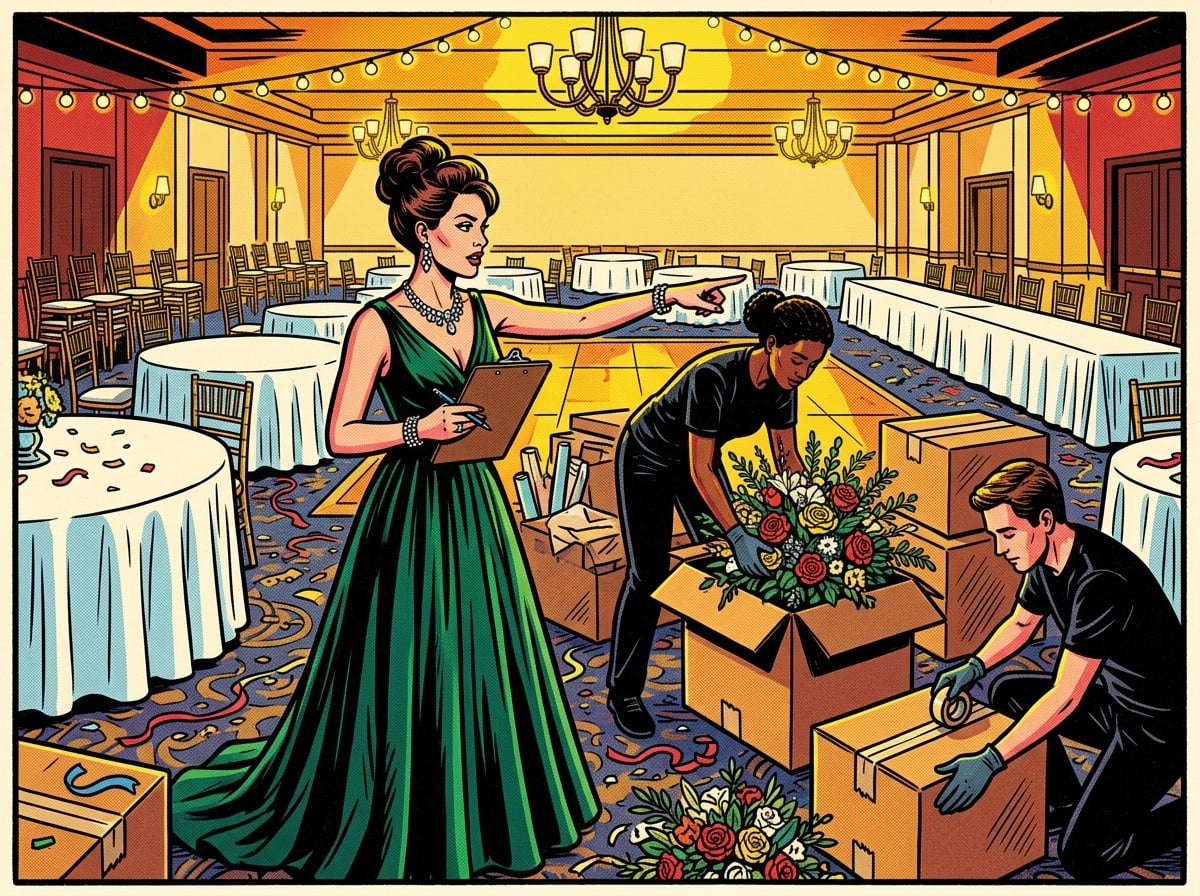
At the end of your reception, someone has to take down the centerpieces, collect the card box, pack up the arch, and load the rental items. That someone is rarely your venue staff – and if you assume it is, you may end up with a late fee or lost items.
Ask your venue: What is your policy on décor removal? Is there a breakdown crew included, or does that fall to the couple or their vendors? What is the venue’s hard-out time, and what happens if items are still there after that window? Some venues charge $150 to $500 for every hour past the contracted end time.
Designate a specific person – a trusted family member, your coordinator, or a hired breakdown crew – to manage end-of-night logistics. Do not assume this will work itself out. Tell that person explicitly what needs to leave, what gets donated, and what gets returned to a rental company.
Pro tip: Give your designated breakdown person a written list with each item, who owns it, and where it goes. Do this before the wedding day, not at 11 p.m. when everyone is tired.
Hair and Makeup Timelines Almost Always Run Over

Every hair and makeup artist will give you a time estimate per person. Those estimates are optimistic. Factor in the bridesmaid who can’t sit still, the mom who changed her mind about her updo, and the unexpected touch-up that adds 20 minutes. The timeline almost always runs longer than planned.
Build in buffer by adding 20 to 30 minutes per person beyond the estimate, and schedule the bride last so she is freshest for photos – not first. Confirm with your hair and makeup team how many artists will be on-site. One artist doing six people will take most of the morning. Two artists cuts that time significantly.
A hard start time for getting ready matters more than most brides realize. If you are supposed to be dressed and ready for first look photos at 1 p.m. and you started an hour late, that delay ripples into every other vendor’s schedule for the rest of the day.
Watch out for: Adding last-minute people to the hair and makeup schedule the morning of the wedding. One extra person can push the entire timeline back an hour. Decide the final list at least a week before.
Your Photographer Needs a Signed Shot List, Not a Verbal One

Telling your photographer “I want all the family combinations” at the reception is not a shot list. A real shot list is a written document that names every grouping, every must-have moment, and every specific detail shot – given to your photographer at least one week before the wedding.
Be specific. Don’t write “family photos” – write out each grouping: bride with parents, bride with siblings, bride with grandparents, full immediate family, groom’s family mirror groupings, and so on. If you have a complicated family dynamic – divorced parents, stepfamilies, or estrangements – note that too so your photographer can plan the sequence efficiently.
A verbal conversation is not enough because your photographer will be managing a hundred moving parts on the wedding day. A written list means nothing gets missed because someone forgot what you said two weeks ago.
Best for: Couples with large families or multiple family units – a detailed shot list can cut your formal portrait time by 20 to 30 minutes because the photographer isn’t figuring out groupings in real time.
Some Venues Ban Open Flames Including Unity Candles

If you are planning a unity candle ceremony, a candlelit aisle, or even simple taper candles on your reception tables, check your venue contract before you order anything. Many venues – especially those in historic buildings, barns, or indoor spaces with low ceilings – prohibit open flames entirely.
Ask your venue coordinator directly: Are open flames allowed anywhere on the property? If so, are there restrictions by area – for example, candles permitted indoors but not in the tent? Some venues allow candles only in enclosed glass holders; others require flameless LED alternatives for everything.
Flameless candles have improved dramatically and many are convincing enough that guests won’t notice. But if a real flame unity candle is meaningful to you, find out now – not the week of the wedding when you’ve already ordered the set.
Smart move: If your venue prohibits open flames, talk to your officiant about a unity ceremony alternative – sand, wine blending, or a ring warming are all meaningful options that don’t require fire.
Tipping Vendors the Night Of Requires Separate Cash Envelopes

Vendor tips are expected in the wedding industry, and most couples plan to tip – but the logistics of actually distributing tips on the wedding night are something almost no one thinks through in advance. Handing someone a Venmo notification while you’re in your gown is not a plan.
Prepare individual cash envelopes before the wedding day, labeled by vendor name or role. Standard tip ranges: DJ 10 to 15% of their fee, photographers and videographers $100 to $300 per person, catering staff 15 to 20% of the food and beverage total (split among the team), hair and makeup artists 20%, coordinator $50 to $200. These are guidelines, not rules – tip based on performance and your budget.
Give the envelopes to your coordinator, best man, or a trusted family member to distribute at the appropriate time during the reception. Do not carry them yourself – you will be busy, distracted, and probably a little emotional.
Pro tip: Put all the envelopes in a single labeled pouch or small bag and write a simple distribution note for whoever is handling them. Make it easy for them to get it right without having to find you and ask questions mid-reception.
Some links in this post may be affiliate links, which means we may earn a small commission if you make a purchase through them. Thank you for your support!