
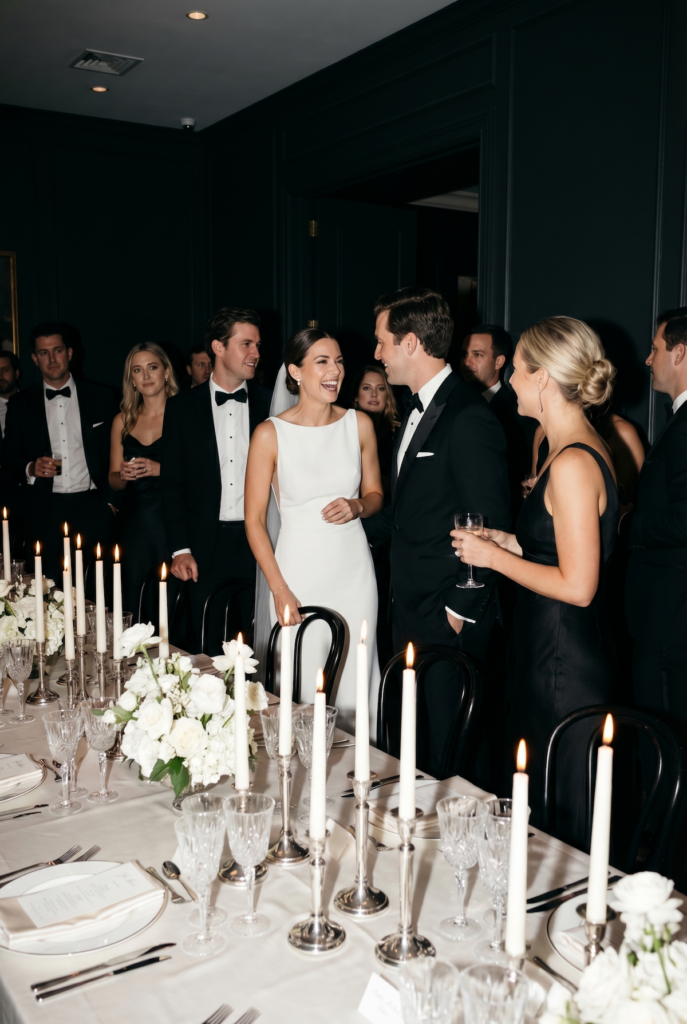
A black-tie wedding can be incredibly chic. It can also go wrong in ways that are hard to name but impossible to miss once you’re in the room. The issue usually isn’t budget. It’s when a wedding is so focused on looking expensive that it loses sight of what actually makes a formal event feel good, restraint, consistency, and a genuine sense that every detail was considered rather than collected.
Most of these mistakes happen not because couples don’t care, but because black tie has a lot of unwritten rules that nobody teaches you. The dress code is the easy part. Everything else is where couples tend to get tripped up.
1. Calling It Black Tie When the Wedding Itself Isn’t
If you’re asking guests to show up in tuxedos and floor-length gowns, the rest of the evening needs to meet them there. This is one of the most common disconnects at formal weddings, couples love the idea of a black tie dress code, but the event itself doesn’t fully support it. A casual outdoor setup, a buffet dinner, a limited bar, or décor that reads as relaxed sends guests a mixed message they feel all night.
Black tie doesn’t have to mean a grand hotel ballroom, but it does need to feel cohesive. The venue, the service style, the invitation wording, and the overall atmosphere should all be pointing in the same direction. When some elements are formal and others aren’t, guests feel that something is off all evening, even if they can’t put their finger on what.
Watch out for: Choosing a black tie dress code because you love the aesthetic, without thinking through whether your venue, service style, and bar program actually match it. The dress code and the event have to be making the same promise to your guests.
2. Buffet Service
Picture it: guests have rented tuxedos, bought gowns, arranged hair and accessories, and arrived at your formal wedding, to find a pasta station. They now have to figure out how to juggle a champagne flute while serving themselves rigatoni in formalwear. Black tie carries an automatic expectation of plated, table-service dining, and swapping it for stations creates a dissonance that runs through the entire evening.
Buffets are wonderful at the right event. A black tie wedding is not that event. The dress code and the service style are two parts of the same promise. If plated service genuinely isn’t in the budget, the right answer is to reconsider the dress code, not to keep the black tie designation and change the service. “Formal attire” or “cocktail attire” paired with beautiful food service you can actually afford is a better outcome than a black tie event with stations.
Smart move: If you love a specific food concept that doesn’t suit formal table service, a mac and cheese bar, late-night sliders, a taco setup, incorporate it as a midnight snack after dinner. It becomes a fun moment the room talks about rather than a contradiction of the dress code.
3. Mistaking More for Better
More florals. More candles. More custom linens. More draping. More signature moments. At a certain point, all of it starts working against itself. A room doesn’t feel luxurious just because every surface has something happening on it, it starts to feel crowded, and the things you actually wanted guests to notice get lost.
The black tie weddings that photograph best and feel best in person almost always have some discipline behind them. They identified what the focal points were going to be, let those details do the heavy lifting, and edited everything else. Restraint is one of the hardest things to practice when you’re deep in planning mode and every option looks beautiful, but it’s what separates a polished formal event from one that just looks expensive.
Pro tip: Before adding any new element, ask whether it makes the room better or just fuller. If the answer is the latter, you have your answer. A few strong details will always outperform a room where everything is competing for attention.
4. Putting the Monogram on Everything
A custom crest or monogram can be a genuinely beautiful detail. The problem is when it starts appearing on the napkins, the dance floor, the bar, the menus, the matchbooks, the welcome bag, the favor box, and the cocktail stirrers. At some point it stops feeling personal and starts feeling like a pattern, and the more places it shows up, the less special any single one of them feels.
One or two custom moments with a monogram or crest reads as intentional and elegant. Saturating the entire event with it reads as the opposite. Choose where it appears with the same discipline you’d apply to any other design element, and let it feel like a considered touch rather than a pattern that repeats itself all night.
Best for: Picking one or two high-visibility moments for a custom monogram, the dance floor, the invitation suite, or a cocktail napkin, and leaving it off everything else. The restraint makes each appearance feel more special, not less.
5. Spending on Flashy Details Instead of Guest Experience
Here’s the clearest difference between a wedding that looks expensive and one that actually feels high-end. Guests remember good food, a strong bar, comfortable seating, smooth logistics, and a timeline that didn’t drag. They remember whether they were well taken care of. They do not remember whether the menu card was letterpress-printed on imported handmade paper if they were starving by the time dinner arrived.
A champagne tower is fun. A custom installation is memorable. But if valet is a disaster, there’s nowhere to sit during cocktail hour, or guests wait 20 minutes for a drink, those problems will define the night far more than any luxury detail will. The elements guests experience directly, service, food, drinks, timing, are where the budget for a formal wedding needs to be protected first. Everything else is secondary.
Watch out for: Cutting corners on catering or bar service to fund a dramatic décor moment. Guests will talk about a great meal and a well-stocked bar for years. They will forget the floral installation by morning if the food was slow or the drinks were watered down.
6. Making It Complicated
Formal should never mean difficult. If guests need multiple emails, confusing transportation instructions, dress code clarifications, and a small research project just to figure out how to attend your wedding, the experience already feels less polished than it should before anyone has arrived.
The most elegant events make everything feel easy. Information is clear and arrives early. Transportation is handled and clearly communicated. People know where to go, when to be there, and what to expect. That sense of ease is part of what makes a formal event feel expensive. It means someone thought the whole thing through from the guest’s perspective, not just the couple’s.
Smart move: Use your wedding website to do the heavy lifting on logistics, transportation details, parking, dress code guidance, timeline. A well-organized guest experience starts before anyone walks through the door.
7. Neglecting the Ceremony
Some couples pour everything into the reception and barely think about the ceremony beyond the basic logistics. But the ceremony sets the tone for the entire evening. If it feels thin, rushed, or visually disconnected from the formality of the rest of the day, guests carry that impression with them into the reception, and it colors everything that follows.
You don’t need to over-decorate it. But it should feel intentional. The music, the seating, the setting, and the pacing should all reflect the level of formality you’ve established everywhere else. A beautiful reception that follows a ceremony that felt like an afterthought makes the whole event feel slightly uneven.
Pro tip: Live music during the ceremony is one of the highest-impact details at a formal wedding and one of the most underinvested. A string quartet for the processional and recessional alone, even if you use a DJ for everything else, elevates the entire event significantly.
8. Stacking Too Many Trends
Trends are not the problem. Loading too many of them into the same wedding is. A black tie event that chases every current moment, metallic everything, sculptural florals in every corner, highly specific décor details chosen because they feel viral, can start looking dated before the photos are even back from the editor.
The weddings that age best start with a classic foundation and layer in a few current touches, not the other way around. At a formal event especially, the foundation matters more than the flourishes. Get the service right, the venue right, the music right, and then let one or two trend-forward details add personality without overtaking the whole thing.
Watch out for: Choosing décor details because they look good in other people’s wedding photos rather than because they belong at your specific wedding. What works in a styled shoot for a magazine may not hold up in a real ballroom over a five-hour evening.
9. Making Formal Feel Cold
Some weddings are so committed to looking polished that they forget to feel welcoming. Black tie should be elegant, but it should still feel warm, alive, and genuinely celebratory. When a wedding is so tightly controlled that guests feel like they’re moving through a beautiful set rather than an actual party, the formality has gone too far in the wrong direction.
Sometimes it’s the timeline, too rigid, with no room for the evening to breathe. Sometimes it’s the room itself, which photographs perfectly but has no energy. Sometimes it’s the overall atmosphere, which feels more like a luxury editorial shoot than a night with people you love. The sweet spot is formal but not stiff. Polished but genuinely warm. That balance is what makes a black tie wedding actually enjoyable rather than just impressive.
Best for: Building in moments that let the evening breathe, a generous cocktail hour, a band that reads the room, a timeline with a little flex built in. The events guests remember fondly almost always had energy, not just beauty.
10. Dressing for the Price Tag Instead of the Fit
This applies to the couple, the wedding party, and a lot of guests too. There’s a certain approach people take when they want to appear expensive, choices that are more obvious than flattering. A gown that wears the bride rather than the other way around. A tuxedo that cost a fortune but doesn’t fit properly. Accessories selected to impress rather than to complete a look.
The most elegant people at a black tie wedding almost always look comfortable in what they’re wearing. Everything fits well. Nothing looks forced. The styling feels considered rather than forced. At a formal event, fit is doing more work than price, a perfectly tailored suit from a mid-range brand will always outperform a designer tuxedo that doesn’t fit.
Smart move: Budget for alterations. A gown or tuxedo that fits perfectly is the single highest-return investment at a formal wedding. Give yourself enough time before the wedding for at least two fittings, and try the full look at home, including shoes, before the day arrives.
11. Working Too Hard to Prove It
This is the thread that runs through all of the other mistakes. Weddings that miss the mark on formality often feel like they’re trying to prove something, that the event is exclusive, that it cost a lot, that the couple has exceptional taste. Every detail is working overtime to announce how special the evening is. And paradoxically, that effort is exactly what makes it feel less special.
The weddings people describe as genuinely elegant rarely get there by doing the most. They’re the ones where someone made confident decisions, stopped before things got excessive, and trusted that the good choices would carry the evening. You don’t need every element to be a moment. That’s what sophistication actually looks like: good editing, good judgment, and a clear sense of what you actually want.
Watch out for: Adding details because they feel like something a formal wedding should have, rather than because you genuinely want them. The most common version of this is saying yes to something beautiful that doesn’t quite belong, and it’s much easier to skip it at the planning stage than to explain it later.
So, What Actually Matters?
A beautiful black tie wedding comes down to a few things done well: a setting that supports the formality, a guest experience that feels easy and generous, details that feel considered rather than crowded, and an atmosphere that’s warm and polished at the same time. None of that requires the biggest budget. It requires the clearest thinking.
The couples who pull off a genuinely elegant formal wedding aren’t the ones doing the most. They’re the ones who understood what black tie actually means, committed to it fully, and let the restraint do the work. That’s what makes a wedding feel expensive in the best possible way, not because nothing feels off, but because everything feels exactly right.
Frequently Asked Questions
What does black tie actually mean for a wedding?
More than most couples realize going in. For guests, it means tuxedos for men and floor-length gowns or formal jumpsuits for women. For the couple hosting, it means an evening event with plated table service, a hosted open bar, live music, formal stationery, and a venue that supports that level of formality. The attire is the visible part, the rest of the standard is what makes it feel like a genuine black tie event rather than a formal-adjacent one.
Is “black tie optional” ever a good idea?
Rarely. It tends to produce a room where half the guests are in tuxedos and gowns and the other half are in dark suits and cocktail dresses, which means nobody looks quite right and the formal atmosphere is already compromised before dinner starts. If your event genuinely meets black tie standards, say so clearly. If it doesn’t, “formal attire” is a more honest designation that gives guests cleaner guidance and produces a better-looking room.
Can you do black tie on a tighter budget?
Yes, with clear priorities. Plated service, a hosted bar, a venue that supports the formality, and quality stationery are non-negotiable. Where couples tend to save successfully: a live quartet for cocktail hour instead of a full band all evening, simpler florals anchored by abundant candlelight, and a curated rather than exhaustive bar. Our guide to saving money on your wedding has more on where cuts actually hold and where they show.
What time should a black tie wedding start?
The reception should start no earlier than 6 p.m., with 7 p.m. closer to the traditional standard. Your ceremony can happen earlier, a 4 p.m. ceremony leading into a 7 p.m. reception is perfectly standard. What doesn’t work is a mid-afternoon ceremony leading directly into a mid-afternoon reception under a black tie dress code. The timing and the dress code need to be consistent with each other.
Do bridesmaids have to wear floor-length gowns at a black tie wedding?
Yes, or at minimum formal midi-length dresses in luxurious fabrics, silk, chiffon, velvet, satin. Your bridesmaids set the visual tone the moment guests walk in. If your guests are in floor-length gowns and your wedding party is in knee-length cocktail dresses, the formality drops immediately and it shows in photos. Mix-and-match styles are fine as long as the silhouette and fabric stay consistent with the evening’s register.
Also Read:
Wedding Venue Red Flags Guests Notice Immediately
15 Wedding Etiquette Rules Every Guest Should Know
Wedding Etiquette and Advice
Some links in this post may be affiliate links, which means we may earn a small commission if you make a purchase through them. Thank you for your support!



Seems like the attire part can really set the tone. Any thoughts on how to handle dress codes better?