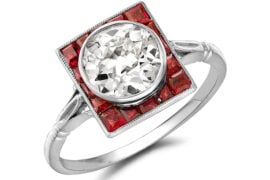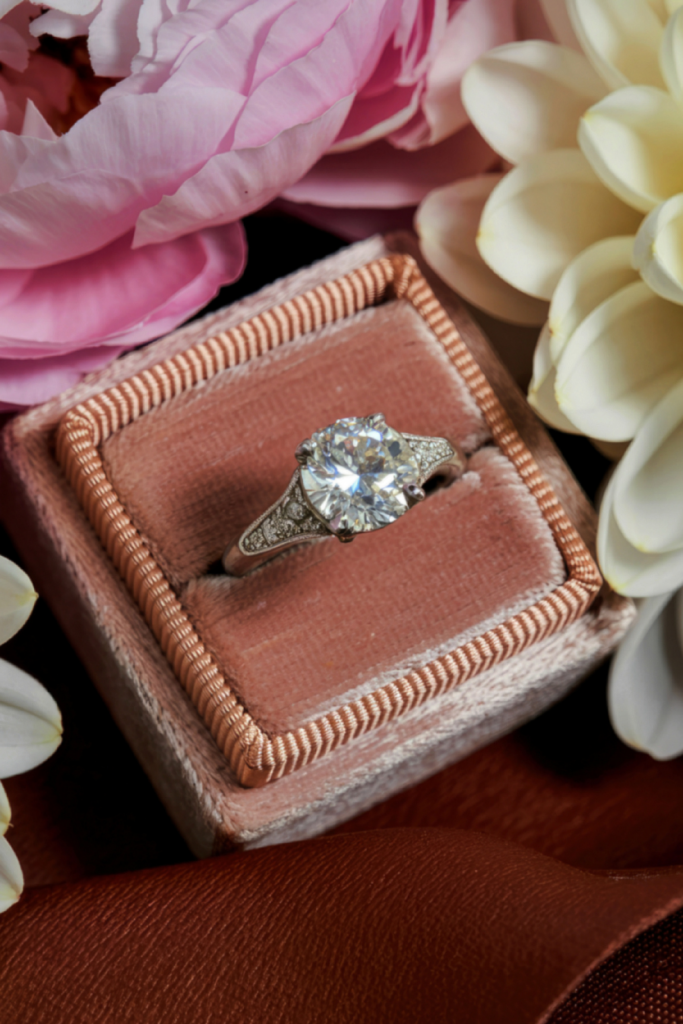
You start out shopping for an engagement ring thinking you want something brand new. Then you wander into one antique shop, see one Edwardian filigree band across a velvet tray, and the whole plan changes.
When you shop links on our site, we may earn a small commission at no cost to you. Learn more.
It’s a pattern we’ve seen over and over again with friends and readers. Antique rings are having a serious moment right now (sustainability, the rise of estate jewelry, plus a real “I don’t want a ring that looks like everyone else’s” vibe), but most shoppers walk into the antique world without knowing the rules.
Here are eight things we wish more brides knew about antique wedding rings before they fell in love with one. A few of them will save you REAL money. One could save your setting from a well-meaning but inexperienced jeweler.
The Quick Version
- Antique = 100+ years old. Vintage is anything from roughly 20 to 100 years.
- The diamond engagement ring is mostly a 1947 invention — colored stones were the older tradition.
- Old cuts (mine, European) sparkle warmer than modern brilliants because they were cut by candlelight.
- Resizing an antique ring is risky. Some pieces simply can’t be resized without damage.
- Per carat, antique diamonds are often cheaper than a comparable new ring, and they look just as big (or bigger) on your hand.
- Antique is one of the most sustainable choices in fine jewelry, period.
1. “Antique” and “Vintage” Aren’t the Same Thing
Most reputable jewelers and auction houses use a strict definition: antique means 100 years old or more. Vintage is the looser term, covering anything roughly 20 to 100 years old. So a 1965 ring is vintage, a 1925 Art Deco engagement ring is antique, and a ring made in 2005 isn’t either of those, no matter how generous the seller is feeling with the wording on the listing.
This actually matters when you’re shopping for a real piece of jewelry history (and not just a pretty repro). Rings sold as antique should predate modern manufacturing, which is a big part of why they look the way they do in the first place. If a piece is being marketed as antique but was actually made in the 1970s, you’re paying for character and history that aren’t really there.
| Term | Age Range | Typical Eras | What to Expect |
|---|---|---|---|
| Antique | 100+ years old | Georgian, Victorian, Edwardian, Art Deco | Hand-cut stones, hand-set details, harder to resize |
| Vintage | 20–100 years old | Retro, Mid-Century, 70s–90s | Mix of hand and machine work, often easier to resize |
| Estate | Any age, previously owned | Any era including modern | Reuse benefit, may overlap with vintage or antique |
| Antique-Style | New (often current decade) | None — it’s a reproduction | Looks old, isn’t old, priced like new |
Spot check: Ask the dealer for a specific decade or era. A reputable antique specialist will say something like “late Victorian” or “early Art Deco” without missing a beat. A vague “early 1900s” is fine for a piece without hallmarks. If you see “antique-style” anywhere on the listing, that’s a tell. It means it’s a new ring made to look old.
2. The Diamond Engagement Ring Is Mostly a 1940s Invention
Before WWII, most engagement rings weren’t diamonds at all. Sapphires, rubies, emeralds, and pearls were considered just as appropriate, sometimes more so. Queen Victoria’s engagement ring was a snake with an emerald set in its head. Empress Joséphine’s was a “toi et moi” with a pear-shaped sapphire next to a pear-shaped diamond.
The shift to diamonds-as-default came from a 1947 De Beers ad campaign with the now-famous “A Diamond Is Forever” tagline, written by an agency copywriter named Frances Gerety. It worked, and it arguably worked far too well. Within a generation, the idea that a “real” engagement ring meant a diamond solitaire was being treated like ancient tradition.
What this means for antique shopping: you’ll find a much wider range of stones in genuinely old rings, and we love that about them. A Victorian sapphire ring or an Edwardian pearl-and-diamond cluster isn’t a “non-traditional” choice. It’s actually the older tradition.
Reality check: If you’ve been told colored stones aren’t “for engagements,” that rule is YOUNGER than your grandmother. (We’ve covered why emerald engagement rings are having a real comeback if you want to go down that path.)
3. Antique Diamonds Sparkle Differently, On Purpose
Modern brilliant-cut diamonds are designed to throw bright white light back at you. They’re cut by computer-guided machines to maximize sparkle under the kind of lighting you find in jewelry store cases, hotel ballrooms, and ring-light Instagram photos.
Antique diamonds were cut by hand, mostly by candlelight, before electricity was a guarantee. The two cuts you’ll see most often:
- Old mine cut: chunky, cushion-shaped, with a small “table” on top and a deep pavilion. Made roughly from the 1700s through the 1880s.
- Old European cut: the round-ish ancestor of today’s round brilliant. More circular than an old mine, with the same chunky hand-cut facets. Most common from the 1890s through the 1930s.
Both look softer and warmer than a modern brilliant, more like glowing embers than little spotlights. They show off in candlelight and natural daylight in a way modern brilliants can’t really compete with, and we love how they photograph in dim, romantic settings (which, when you think about it, is exactly when most people will be looking at your ring).
Pro tip: Don’t compare an antique cut to a modern one in a brightly-lit jewelry store. The lighting in those cases is rigged in favor of the new ring. Look at the antique stone in the kind of light you’d actually wear it in.
4. There Are Five Distinct Eras, and Each One Has a Look
Once you start shopping, knowing which era a ring is from will save you a lot of guessing. The five eras most antique dealers will reference:
- Georgian (1714–1837): rare, often hand-set in silver-topped gold. Stones are usually closed-back (foiled behind to enhance color). Very few survive in everyday-wearable condition.
- Victorian (1837–1901): a long era with a lot of variety. Early Victorian was romantic and sentimental (snake rings, hearts, hidden compartments). Mid- and late-Victorian leaned into diamonds, ovals, and clusters.
- Edwardian (1901–1915): platinum filigree, lacy “garland” details, lots of milgrain edges. This is the era of the most delicate, ornate engagement rings.
- Art Deco (1920–1935): geometric, bold, graphic. Step cuts, baguettes, calibré-cut sapphires and emeralds in geometric layouts. Most of what people picture when they hear “vintage engagement ring” is actually Art Deco.
- Retro (1935–1950): chunky, sculptural rose gold and yellow gold, often with bigger stones. Less popular for engagements today, but they’re having a real moment again.
Insider note: Edwardian and Art Deco are the two most-collected eras and tend to command the highest prices on the market. If your budget is tight, late Victorian and Retro pieces are usually a much better value for a ring that looks just as big on your finger.
5. Many Have Secret Engravings Inside the Band
Engraved interiors were standard practice in Victorian and Edwardian rings. Sometimes it’s a date, sometimes a set of initials, occasionally a longer sentiment from the original couple that gives you full goosebumps the first time you read it.
The most common Victorian engraving is “Mizpah,” a Hebrew word from Genesis that translates roughly to “the Lord watch between me and thee while we are absent one from another.” It was used as a sentimental promise between people who’d be parted for stretches of time. You’ll also see things like “Forever,” “From R.T. to E.M. 1898,” or sometimes just initials and a date.
If you’re buying an antique ring, always ask the jeweler to check the inside of the band before you commit. Some buyers fall in love with the history of someone else’s engraving and want to keep it on the ring forever. Others prefer to have it polished out and their own added (which is sometimes possible and sometimes not, depending on the metal and the depth of the original cut).
Heads up: If the engraving feels too personal for you to wear, you can usually have the inside re-finished and your own message added in its place. Just confirm with a specialist that it won’t compromise the band before you commit to the work.
6. Resizing One Can Wreck It
This is the single biggest risk most people don’t think about until after they’ve already bought the ring and brought it home, and we genuinely cannot say it loud enough.
Antique rings, especially Art Deco geometric designs and Edwardian filigree, were not made to be resized the way modern rings are. The metal can be delicate, the settings are intricate, and on Art Deco pieces the side stones (calibré-cut sapphires, baguettes) are cut to a specific shape that can’t shift with the band. Sizing up or down by more than a half-size can crack a setting, distort the engraving, or worst case, pop a stone out entirely.
If you’re ordering an antique ring online, the safest move is to get your finger sized by a jeweler first, then look for a piece that’s already within a half-size of where you need it. Some pieces simply can’t be resized, and a good antique dealer will tell you that upfront rather than after the sale.
Watch out for: Sellers who say “of course we can resize it” without actually looking at the construction. A specialist will examine how the band is built before quoting you anything. A non-specialist might do real damage and charge you for the privilege.
7. They’re Often Cheaper Than New Rings With the Same Carat Weight
This one catches a lot of buyers genuinely off guard. A one-carat antique diamond in an Edwardian setting often costs less than a one-carat new diamond in a comparable modern setting, sometimes meaningfully less. Old cuts aren’t graded on the modern GIA scale (no lab graded a stone cut in 1910), so the same per-carat market doesn’t really apply.
There are exceptions worth knowing about. Signed pieces from major houses (Cartier, Tiffany & Co., Van Cleef & Arpels) can run several times the price of an unsigned piece of similar quality. So can rare stones (natural color sapphires, no-heat rubies) and exceptional Art Deco designs. But for the average shopper looking at the average antique ring, you’re often getting more visible ring for the budget.
Smart move: Compare on how big the ring actually looks on your finger, not on stone grading numbers. The whole point of an antique ring is what it looks like when you wear it. A 1.2-carat old European cut in a hand-engraved platinum mounting will look bigger and feel more substantial than a 1.5-carat modern brilliant in a thin solitaire setting.
8. They’re One of the Greenest Choices in Fine Jewelry
Antique rings have already been mined, cut, and set, sometimes more than a hundred years ago. Buying one means no fresh mining of any stones, no additional refining of metal, and the manufacturing footprint of the piece was already absorbed decades ago. You’re effectively reusing what already exists.
That makes antique rings one of the most sustainable choices in fine jewelry, even compared to lab-grown diamonds (which take significant energy to produce) or new rings made with recycled metals (which still require manufacturing). For couples who care about the environmental and ethical footprint of what they’re putting on their hand for the rest of their lives, an antique ring is genuinely hard to beat.
Worth knowing: The same logic applies to “estate” rings, which are pieces resold from a previous owner even if they’re not technically 100 years old. You skip the historic-piece premium but still get the reuse benefit.
Antique and Vintage Wedding Rings We’re Loving on Etsy Right Now
A handful of standouts we’ve been eyeing on Etsy this week. Six are properly antique (100+ years old), and two are vintage Retro pieces from the 1950s and 1980s that earn their spot on the list. Prices and availability shift FAST on Etsy, so if you fall in love with one of these, grab it quickly.
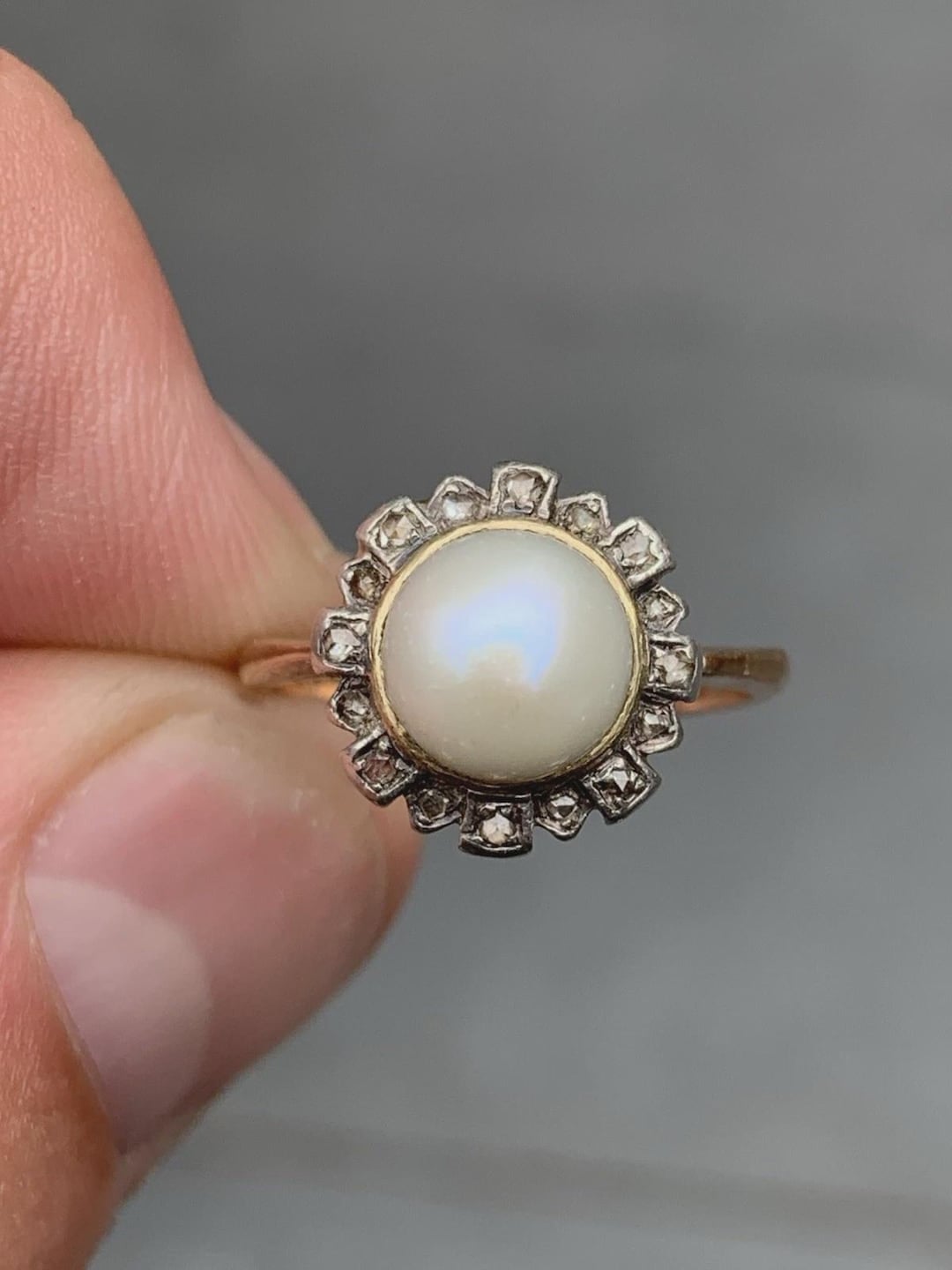
Victorian Pearl & Rose Cut Diamond Cluster Ring
This one is a late-Victorian beauty: a pearl center surrounded by rose cut diamonds in a 9k rose gold cluster setting. It’s exactly the kind of “older-than-the-diamond-tradition” engagement style we mentioned earlier in the post, and the cluster format makes it look bigger on the finger than the stone weights alone would suggest.
Era: Victorian | Shop: JanPalmerAntiques (Vista, CA) | Price: $875 | Size: 6
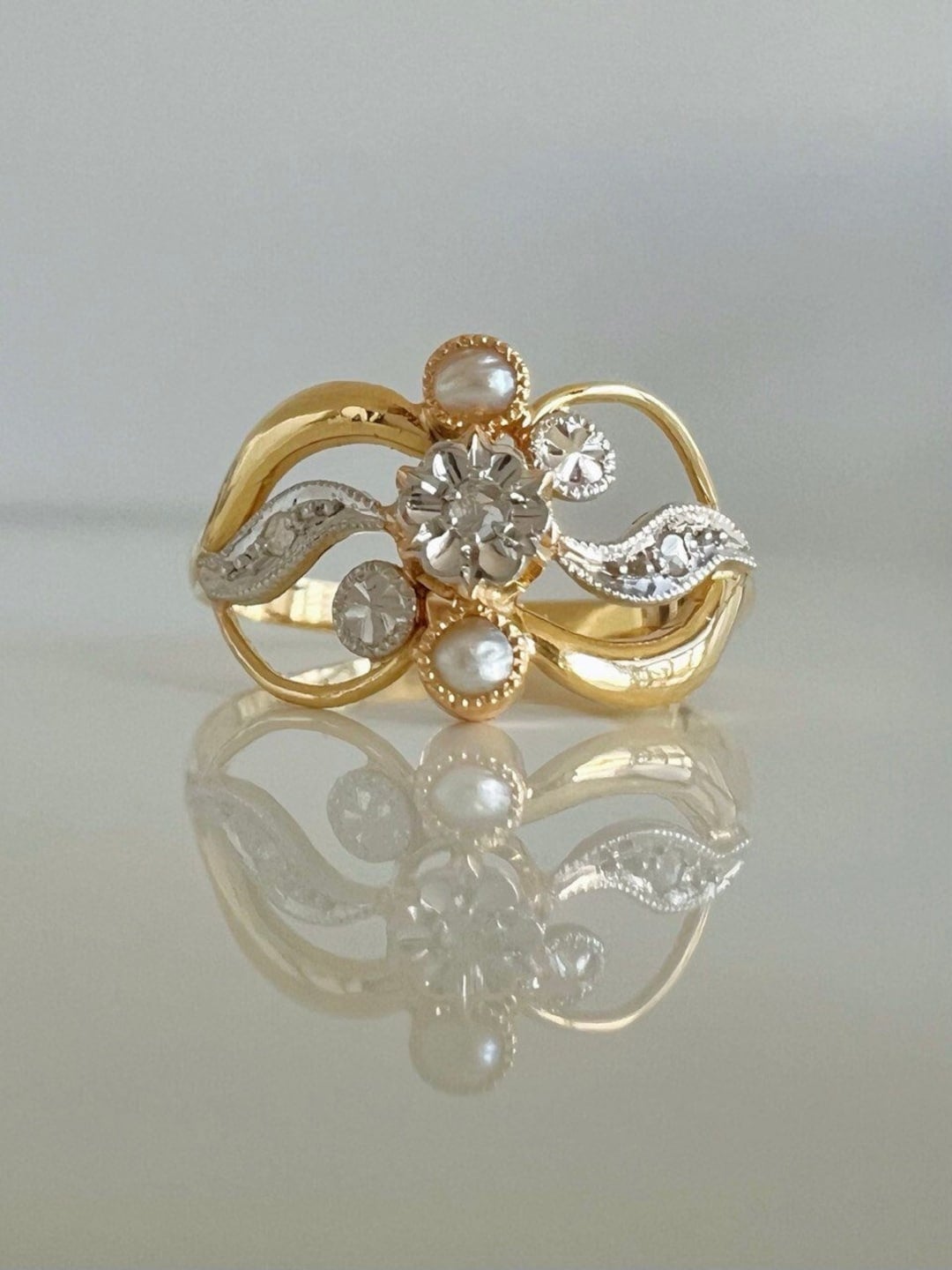
Authentic Art Nouveau 18K Gold Ring
Art Nouveau pieces (roughly 1890–1910) bridge the Victorian and Edwardian eras with flowing, nature-inspired curves and asymmetric details that feel completely different from anything made today. We love this one for buyers who want something genuinely unusual, and the 18K gold means it’ll wear like a tank.
Era: Art Nouveau | Shop: StellarTales (Netherlands) | Price: $885
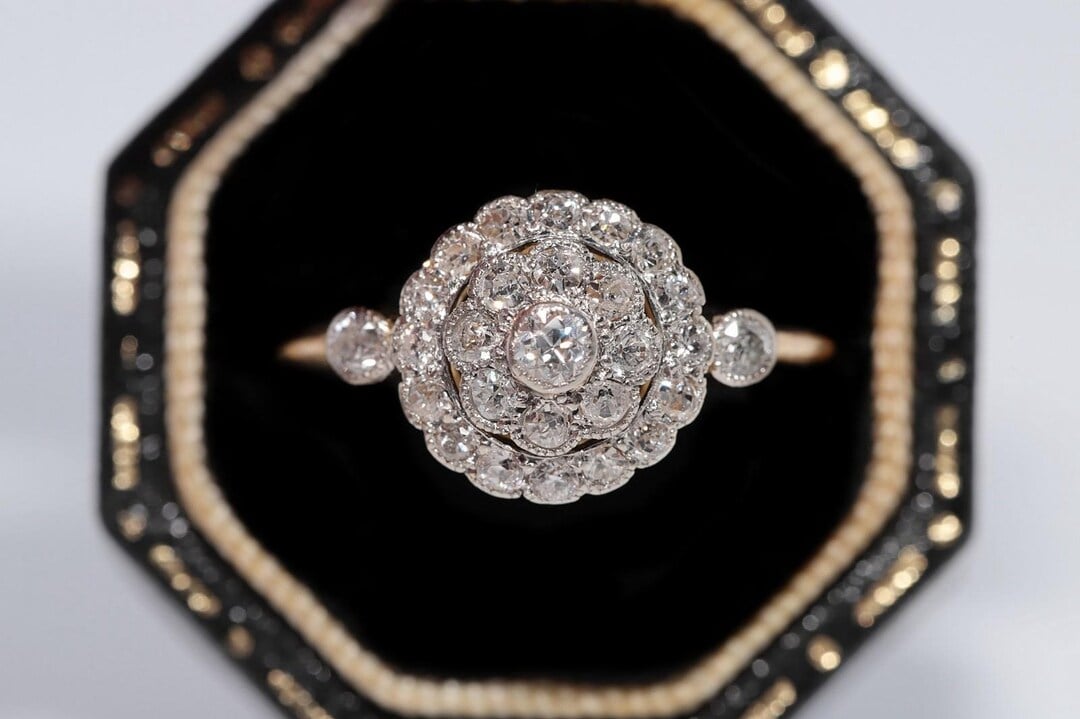
Circa 1900s 18k Gold Old Cut Diamond Ring
This is a textbook example of the old cut sparkle we talked about earlier: handcrafted setting, a natural old cut diamond that throws warm light instead of bright spotlight flash. It’s a real Edwardian-adjacent piece that would feel right at home as either an engagement ring or a meaningful right-hand ring.
Era: Edwardian (early 1900s) | Shop: VintageJewelryByEsra (Türkiye) | Price: $1,600
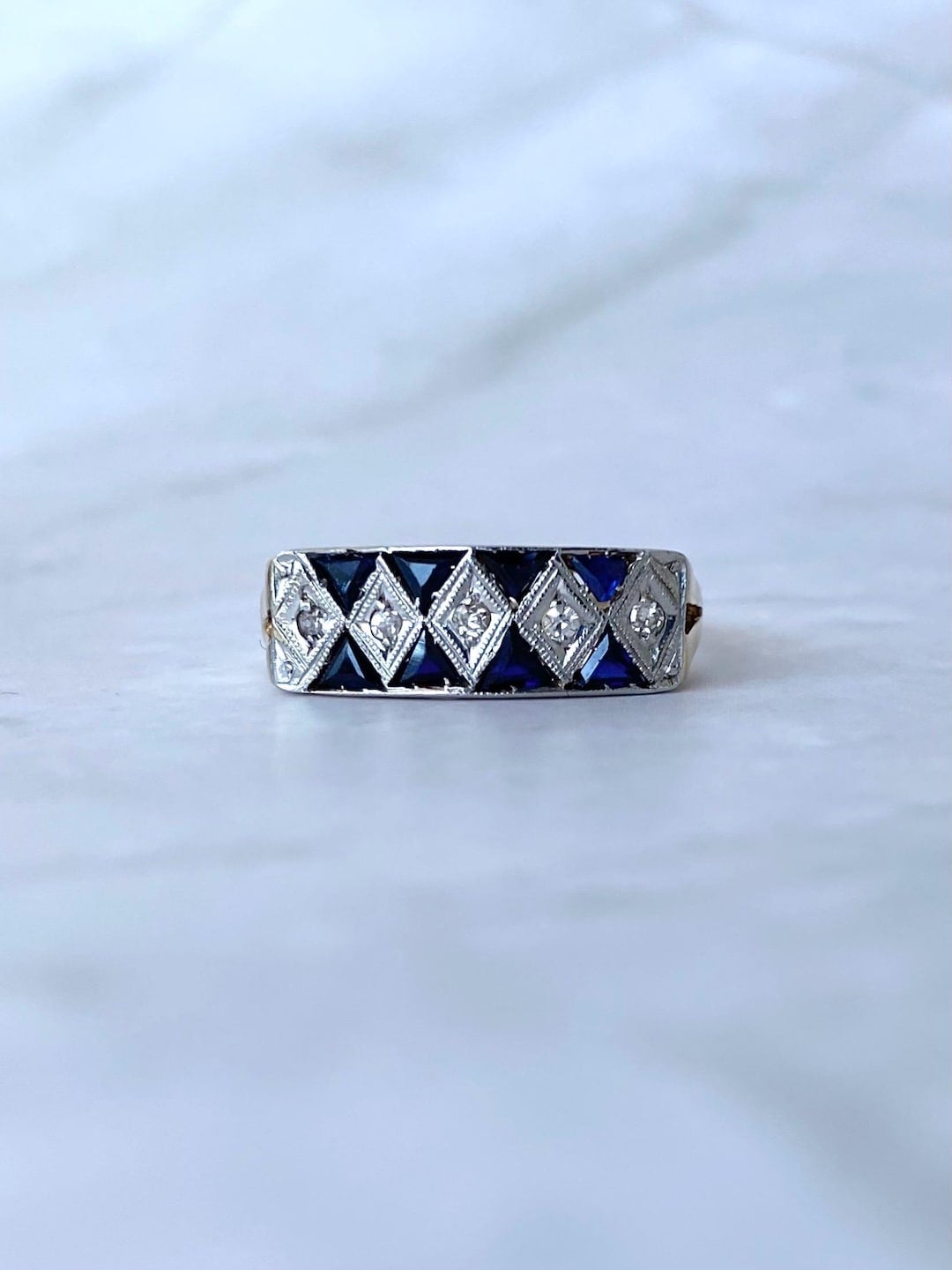
Art Deco Sapphire & Diamond 18ct Gold Ring
If you’ve been picturing an “antique engagement ring” in your head, there’s a strong chance this is what you’re picturing: crisp Art Deco geometry, a classic sapphire-and-diamond combo, all in 18ct gold. It’s the kind of piece you simply don’t see in a regular jeweler’s case.
Era: Art Deco (1920s–30s) | Shop: HouseOfGoldenRings (Australia) | Price: $1,000
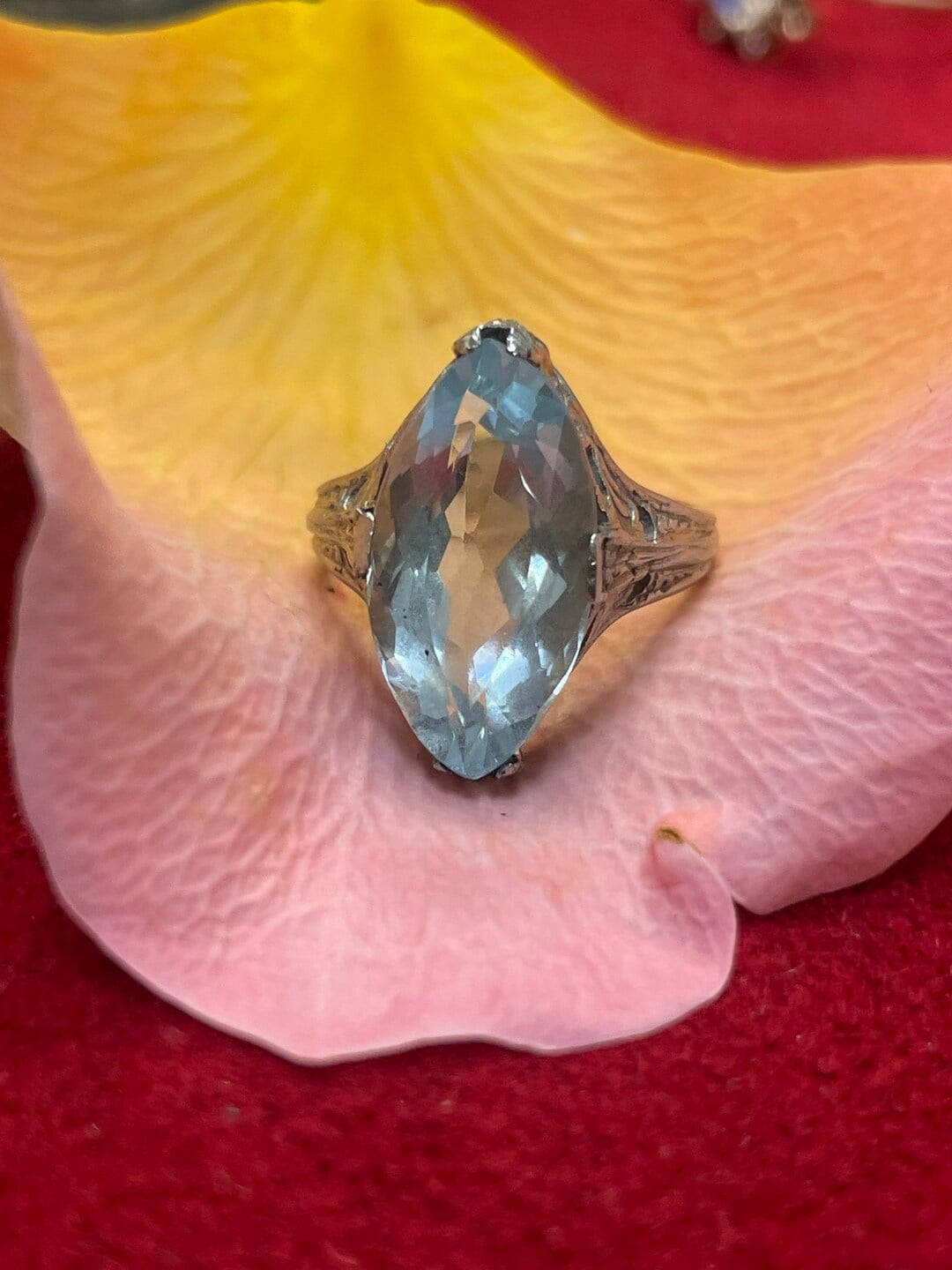
1920s Art Deco 5CT Marquise Aquamarine Ring
This one is a real statement piece. It’s five carats of natural marquise-cut aquamarine in 18K white gold, properly Art Deco, and the seller notes it’s a size 3.25 that can be sized up. That’s exactly the kind of thing to ask a specialist about (re-read #6 if you skipped ahead).
Era: Art Deco (1920s) | Shop: Faxxelange (Miami, FL) | Price: $795
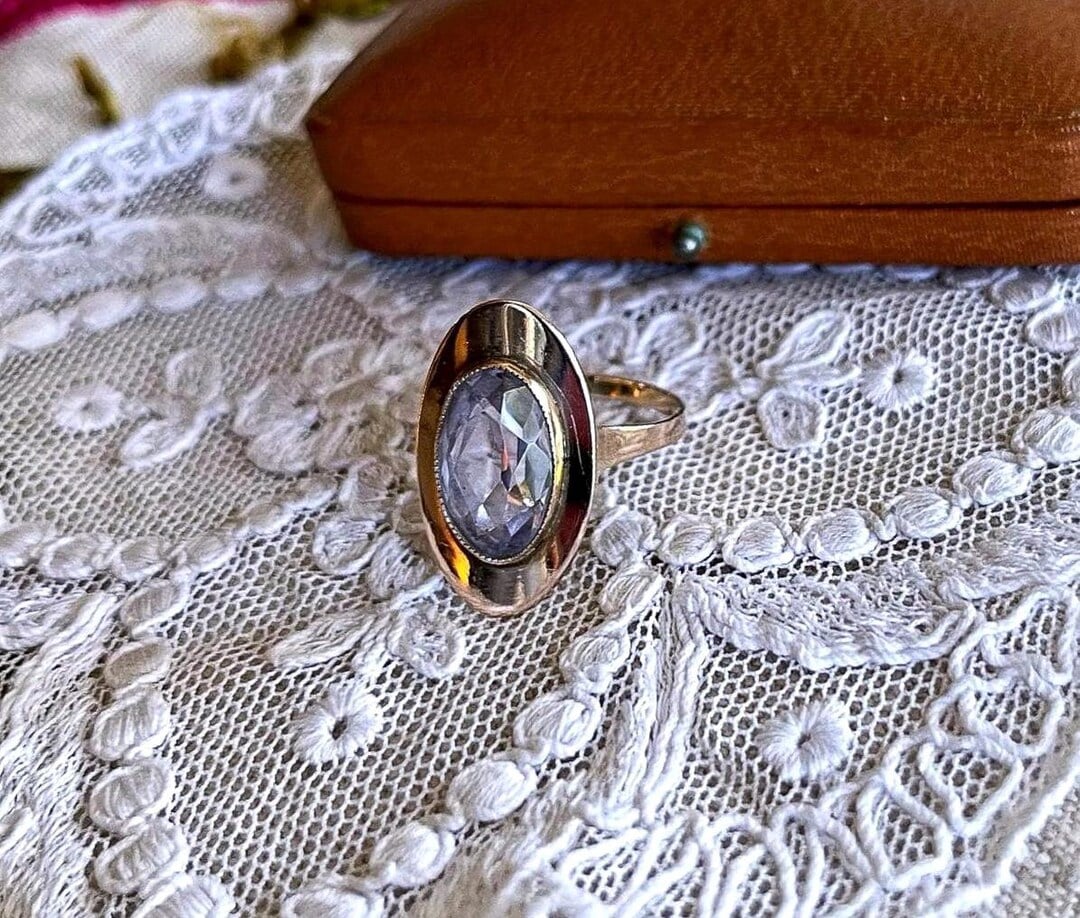
Antique 8K Gold Purple Spinel Cocktail Ring
This is the most budget-friendly true antique on the list, and a great example of why colored stones used to be the engagement default. It’s a faceted purple spinel in 8K yellow gold, hallmarked, and ready-to-wear in size 7.75. We love this one for anyone who wants a piece with real history without the four-figure commitment.
Era: Antique | Shop: Carolannstudios (Irvine, CA) | Price: $391.99 | Size: 7.75
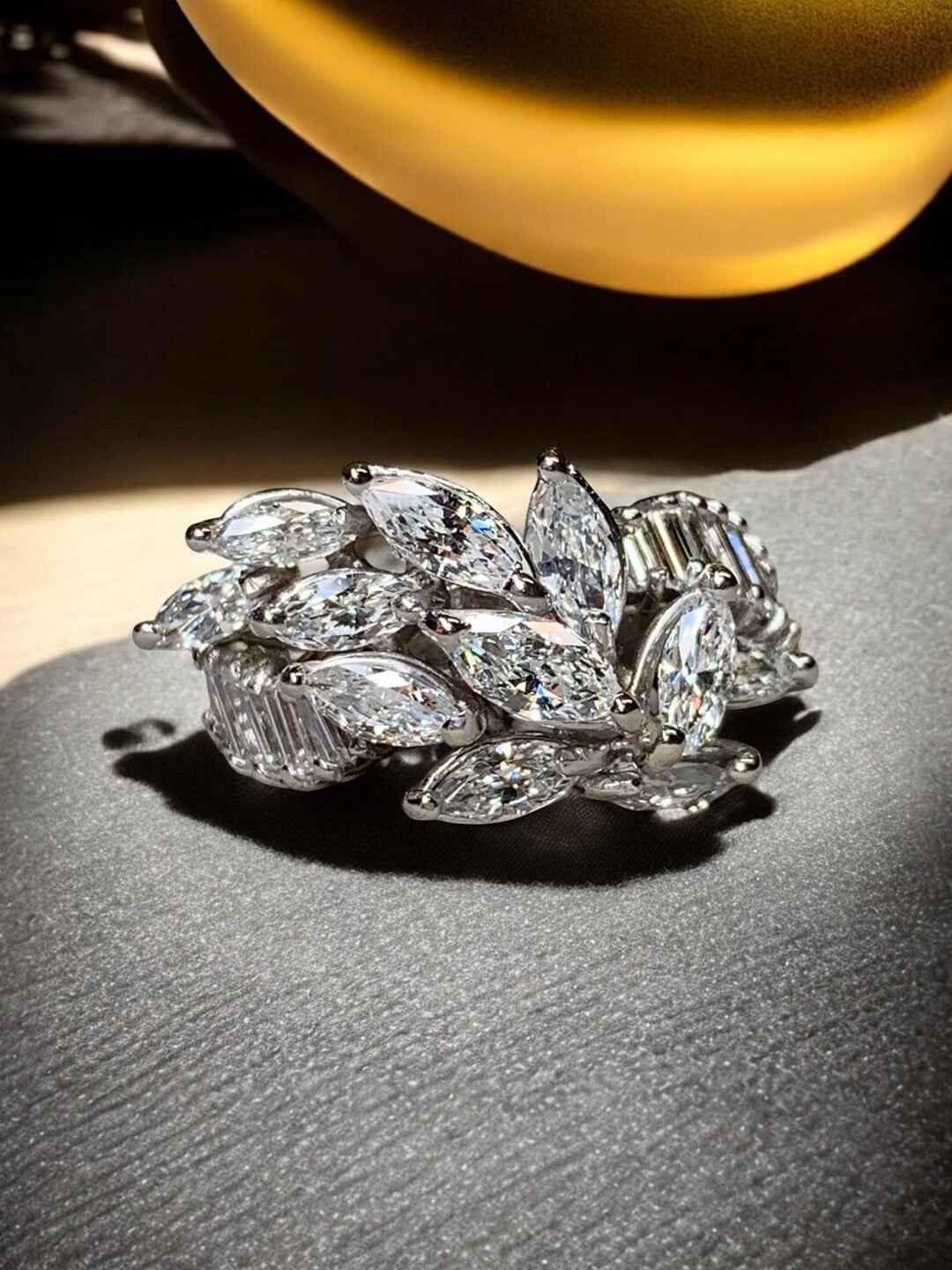
1950s Platinum Marquise Baguette Cocktail Ring
This one is technically vintage, not antique (it’s about 75 years old, see #1). But it’s such a beautiful Retro-era piece (platinum, marquise and baguette diamonds in a sculptural spray, G/VS quality) that we wanted to include it for anyone considering the Retro look we mentioned earlier in the post.
Era: Retro / vintage (1950s) | Shop: FoxEstateJewelryFL (Winter Springs, FL) | Price: $3,500
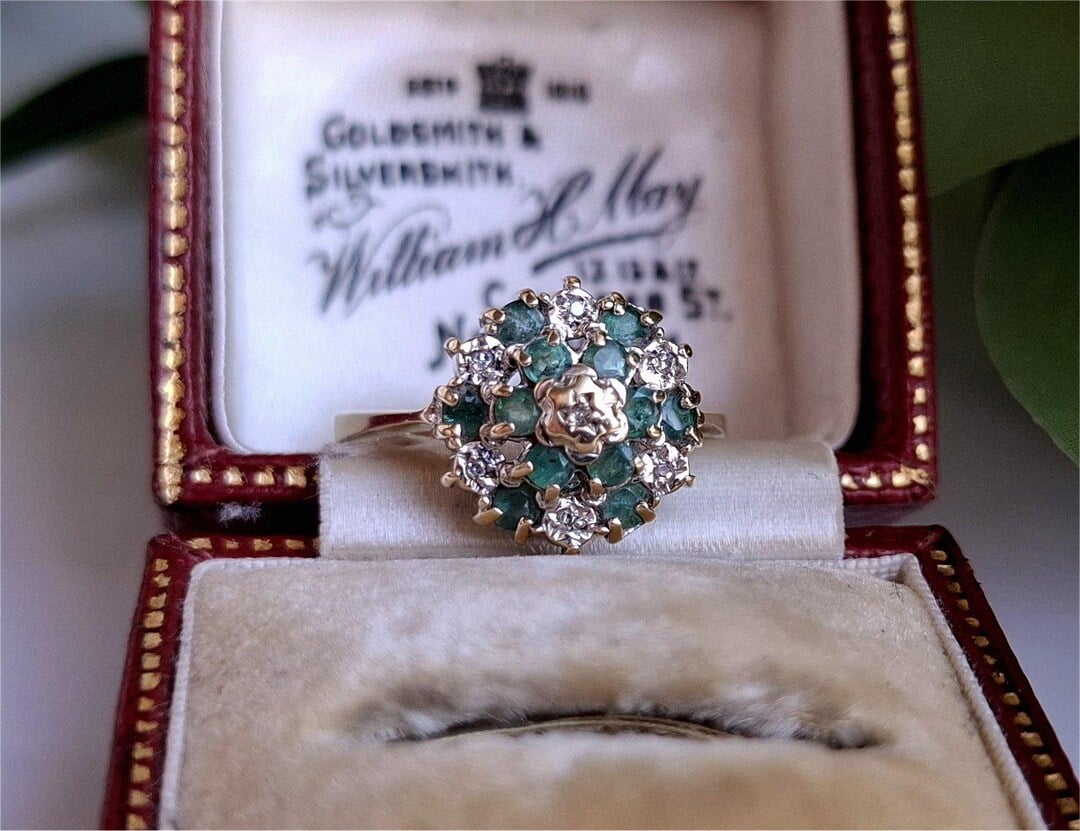
1980s 9ct Gold Emerald & Diamond Ring
This one is also vintage rather than antique, but at this price point we couldn’t leave it off. It’s an emerald center with diamond accents in 9ct gold, and the seller offers resizing on this one (which, as you now know, is not always a given). A flexible option for buyers who don’t want to play size roulette.
Era: Vintage (1980s) | Shop: SimplyMrVintage (UK) | Price: $500
Before You Buy: The Antique Ring Checklist
Save this one. If you’re getting close to clicking “buy” on an antique ring, these are the questions we’d ask before sending the money.
- What’s the era and approximate decade? A real specialist will give you a specific answer, not a vague one.
- Are there hallmarks or maker’s marks? If yes, ask what they mean. If no, ask why (some pieces predate hallmarking laws, which is fine).
- Can this ring be safely resized, and by how many sizes? Get a specific answer in writing.
- What’s the condition of the prongs and setting? Antique prongs wear down. A good dealer will note any retipping that’s been done.
- Are the stones original to the piece? Replacement stones are common and not necessarily a deal-breaker, but they should be disclosed.
- Is the inside of the band engraved? Ask for a photo if you can’t see it in the listing.
- What’s the return policy? Aim for at least 7 days. Online, ideally with the option to take it to your local jeweler before final sale.
- Has it been appraised, and when? If you’re insuring it, you’ll want a recent appraisal from a specialist.
So, What Actually Matters?
You don’t need to memorize every era and every cut before you start shopping. You just need to know enough to ask the right questions: how old is it really, what era, can it be safely resized, what’s the cut, are there hallmarks or maker’s marks inside the band.
A good antique specialist will walk you through all of that without pressure. A regular jewelry chain probably won’t, because antique pieces aren’t their core business and the staff often hasn’t been trained to evaluate them. Find a dealer who specializes (most major cities have at least one good one, plus great online options like Erstwhile, Trumpet & Horn, and 1stDibs), or buy from an established seller with a transparent return policy. We always recommend at least one in-person try-on if it’s possible. (And if you’re earlier in the planning process, our how to plan a wedding guide walks through the whole timeline.)
The best part of buying antique: every ring already has a story, and yours becomes the next chapter. That’s not a small thing on a piece of jewelry you’re going to wear every single day for the rest of your life.
Related Reading
- A Closer Look at Vintage Engagement Rings (and How They’re Different from Antique)
- Why Emerald Engagement Rings Are Having a Real Moment
- The Oval Engagement Ring Style Guide
- 3 Things You Definitely Want to Know About Your Wedding Ring
- How to Plan a Wedding (Our Full Timeline)
Quick Questions, Quick Answers
Are antique wedding rings durable enough for everyday wear?
Most absolutely are, especially Art Deco pieces in platinum (which were genuinely built like tanks). Some Edwardian filigree settings are more delicate and may benefit from a protective rebuild or a “for special occasions” rotation. Ask the dealer specifically about everyday wearability before you commit.
Can I get an antique engagement ring with a matching wedding band?
Yes, but probably not from the same era. Most couples either find a contoured modern band that fits the antique ring’s profile, or have one custom-made by a jeweler who specializes in antique-compatible work.
How do I insure an antique ring?
Get an appraisal from a specialist who actually knows antique pieces, not a regular mall jeweler. The appraised value should reflect the era, condition, and any signed-piece premium. Then add a rider to your homeowner’s or renter’s policy, or use a dedicated jewelry insurer like Jewelers Mutual.
What’s the safest way to buy an antique ring online?
Stick to established dealers with detailed return policies (at least 7 days, ideally with the option to send the ring to your local jeweler for evaluation before final sale). Always confirm resizing limitations and ask for additional photos in natural light before buying.
Is an antique ring a good investment?
Sometimes. Signed pieces (Cartier, Tiffany & Co., Van Cleef & Arpels) and rare stones tend to hold or grow value over time. Most unsigned antique rings are bought for the love of the piece, not as financial assets. Buy because you love it, and treat the value question as a bonus.
How can I tell if a ring is really antique versus a really good reproduction?
The construction tells the story. Real antiques show subtle hand-tool marks, slightly uneven prongs, and metal that’s softer than modern alloys. A specialist or experienced antique dealer can identify these in seconds. If you’re shopping online, ask for close-up photos of the gallery (the underside of the setting) and the inside of the band.