
Wedding florals are the fastest way to make your ceremony feel like a high-end luxury venue — and the fastest way to blow your entire wedding budget in one vendor meeting.
So here’s the wedding budget hack that savvy couples are using to save thousands: design your floral arrangements to be moved and reused strategically throughout your event. Not just “repurpose your bridal bouquet as a centerpiece” — that’s amateur hour. I mean: invest in statement luxury arrangements once, position them where your professional wedding photographer will capture the most impact, and then have your wedding coordinator relocate them to your reception venue so you’re not paying two separate floral invoices for the same wow factor.
To be clear: professional florists are talented wedding vendors who deliver incredible value. This isn’t a conspiracy — it’s simply that most couples don’t know to request a floral reuse plan when comparing wedding packages, and most floral proposals are quoted as if every moment of your event requires its own full installation. With the right planning strategy, you can absolutely achieve that luxury wedding aesthetic without double-buying flowers.
If you want the bigger picture on what’s worth spending on (and what’s not), start here: where to save and splurge in your wedding budget.
The Hack: Stop Buying Separate Ceremony and Reception Florals
Most wedding floral budgets quietly balloon because you’re paying for two categories of the same thing:
- Ceremony “wow” (arch, aisle, altar/meadow)
- Reception “wow” (head table, sweetheart table, entry, bar, statement moments)
The hack is to concentrate your biggest pieces where they can do double duty. Ceremony first (because photos), then move those exact pieces to your reception focal points.
It’s not “cheap.” It’s strategic. And your guests will just assume you’re a genius with taste and priorities.
The 3 Places You Should Put Your Biggest Arrangements First
If you’re going to spend real money on flowers, put them where they’ll be:
- In your ceremony photos (hello, forever album)
- Behind you (the background of your vows and family shots)
- At your reception focal point (head table/sweetheart table, entry, bar)
That’s why the ideal “reuse” plan usually starts with one of these:
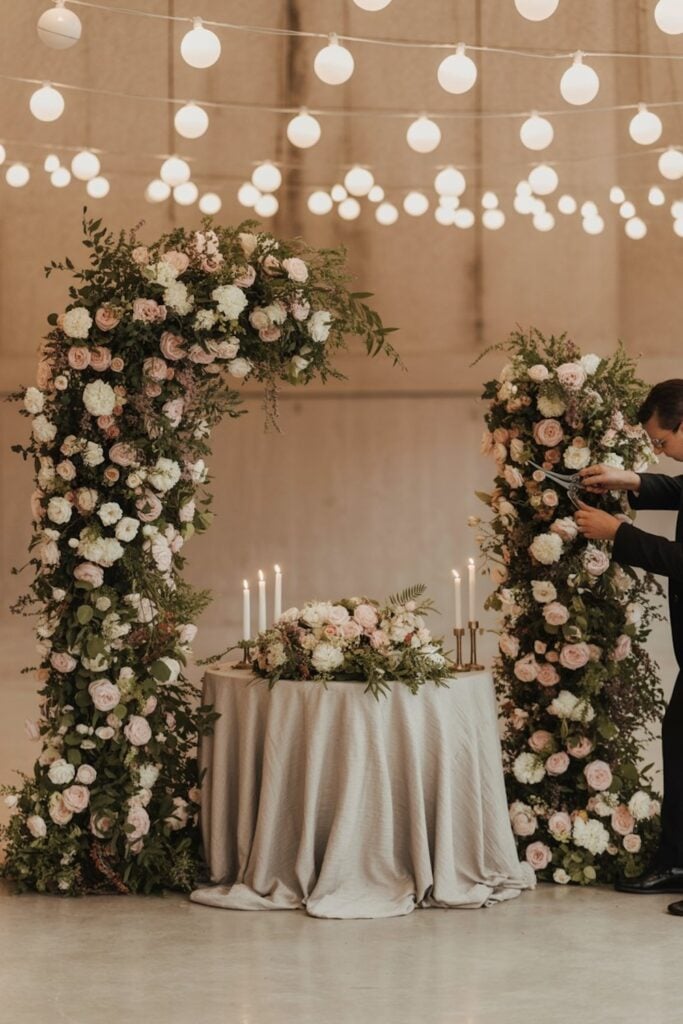
- Two large ground arrangements flanking your ceremony (instead of a full arch)
- A ceremony “meadow” at the altar that can be split into multiple reception moments
- A set of aisle clusters that become bar/escort card table/guestbook flowers
If you’re still finalizing the flow of the day, this also pairs perfectly with a seating card setup that’s actually easy for guests (because nothing kills the vibe like a crowd of people panic-reading tiny cards).
Are you overspending on your wedding? This 60-second quiz will tell you.
Most brides go into planning with a number in their head and no idea where it's actually going. Enter your budget and guest count, and get a clear picture of exactly where your money is at risk, what you're most likely to overspend on, and where you can cut without anyone noticing.
What matters most to you?
Every vendor will tell you: unless you have an unlimited budget, you HAVE to prioritize. Tell us what matters most to you so your results are specific to YOUR wedding — not some generic checklist.
Your budget has a blind spot.
What’s inside your results
📊Your budget score & #1 blind spot
⚠️Your biggest pressure point
💡Where you’re most likely to overspend & save
💰Your recommended budget breakdown
No spam. Unsubscribe any time.
The Move That Saves the Most Money: Skip the Arch, Go Grounded
If you want one simple rule: a full floral arch is a budget trap unless you have the budget to not care.
Arches cost a lot because they require:
- more stems (it’s a big structure)
- mechanics (foam/cages/wiring/support)
- labor (build + install + often strike)
A smarter alternative that photographs insanely well: two statement ground arrangements or a lush “meadow” at the ceremony spot. You get the same romantic, editorial look in photos, but those pieces are designed to move.
Then after the ceremony, those arrangements become:
- your sweetheart/head table focal flowers
- your entry moment
- your bar flowers
- your cake table styling
Same flowers. More time on camera. Less money wasted.
Also: if you want a quick gut-check on where your money is going, it helps to see a realistic wedding budget breakdown so your floral line item doesn’t quietly become a whole personality.
What to Ask Your Florist (So This Actually Works)
This only works if your florist designs with the move in mind. Here’s the exact language to use:
“Can you build our ceremony florals so they can be repurposed at the reception? We’d love a reuse plan that moves key pieces to the sweetheart/head table, bar, and entry.”
Then ask these follow-ups:
- “Which pieces are designed to move?” (Ground arrangements, aisle clusters, pedestal pieces, compotes.)
- “What does the move cost in labor?” (It’s usually far less than buying a second set of large arrangements.)
- “Who is responsible for moving them?” (Ideally the florist team or planner—not your cousin in a tie.)
- “Will the pieces look good in both locations?” (Translation: stable bases, no fragile mechanics, clean backs if visible.)
You’re not asking them to do extra for free. You’re asking them to design smart and allocate budget to impact.
If you’re the type who likes a checklist, you’ll also love a guest comfort checklist—because the best weddings look good and feel easy.
The Biggest Mistake People Make Trying to Reuse Flowers
They try to reuse everything.
That’s how you end up with a chaotic game of floral Tetris and a planner who looks like they’re about to walk into the ocean.
The smarter move is: reuse only the expensive, high-impact pieces. Keep the rest simple and consistent.
Translation:
- Reuse: ceremony meadow, large altar pieces, pedestal arrangements, aisle clusters
- Keep simple: centerpieces (bud vases, small compotes), cocktail tables (single stem), bathroom flowers (tiny)
And yes, you can still have a reception that feels lush. The secret is focusing your “big” moments where people actually look: entry, bar, sweetheart/head table, and your wedding entrance.
Where You Should Spend (and Where You Should Relax)
If you want your wedding to look and feel elevated without hemorrhaging money, prioritize:
- One “hero” moment (ceremony meadow or large grounded arrangements)
- Reception focal point (sweetheart/head table, entry, bar)
- Lighting (candles + warm uplighting make flowers look richer)
And relax on:
- Ceremony aisle markers for every row (do every other row, or just the front third)
- Overly complex centerpieces (simple can look editorial)
- Flowers in places people don’t linger (random corners, hallways, etc.)
Quick reminder: guests remember how your wedding felt, not whether every single surface had flowers on it. If you want a reality check on what people actually notice, you’ll love this: things guests won’t notice (and you won’t remember).
A Realistic Reuse Map You Can Copy
Here’s a clean plan that works for most weddings:
- Ceremony: two large grounded arrangements at the altar + 6–10 aisle clusters
- Reception: move the two large arrangements to your sweetheart/head table or behind it
- Cocktail hour: move aisle clusters to the bar, escort/seating card table, guestbook table, and lounge areas
Bonus if you’re doing a sweetheart table: it’s basically built for this. You get a “wow” background without paying for a second installation.
If you’re still sorting out the logistics of where people go (and when), having a simple wedding timeline makes this whole plan ten times easier to execute.
Quick Checklist (So Your Florals Don’t Fall Apart During the Move)
- Stable bases: compotes, urns, weighted vessels, or sturdy ground mechanics
- No fragile “one-sided” pieces if they’ll be seen from behind later
- A dedicated move window built into the timeline (your planner can coordinate)
- Clear destination plan (exactly where each piece goes after the ceremony)
If you do nothing else: ask for a reuse plan and a move quote. Even with extra labor, you’re usually spending less than you would on duplicate “wow” arrangements.
Are you overspending on your wedding? This 60-second quiz will tell you.
Most brides go into planning with a number in their head and no idea where it's actually going. Enter your budget and guest count, and get a clear picture of exactly where your money is at risk, what you're most likely to overspend on, and where you can cut without anyone noticing.
What matters most to you?
Every vendor will tell you: unless you have an unlimited budget, you HAVE to prioritize. Tell us what matters most to you so your results are specific to YOUR wedding — not some generic checklist.
Your budget has a blind spot.
What’s inside your results
📊Your budget score & #1 blind spot
⚠️Your biggest pressure point
💡Where you’re most likely to overspend & save
💰Your recommended budget breakdown
No spam. Unsubscribe any time.
Some links in this post may be affiliate links, which means we may earn a small commission if you make a purchase through them. Thank you for your support!


